Showing posts with label cultural analysis. ethnography. Show all posts

Sunday, July 18, 2021

Ghost in The Shell (1995):

Ghost in The Shell (1995):

Ghost in The Shell is about a cyborg spy woman (Major Makoto Kusanagi) working for the intelligence agency Section 9 to track down The Puppetmaster who hacks into people’s brains making them commit terrorist actions they can’t remember through their “ghosts” or computer brains. While it is uniquely 90s in its presentation of tech, with wires and virtual realities galore, its philosophy is both uniquely Japanese, and timeless. In the first scene we see The Major taking down some terrorist separatists negotiating with the gov’t. She guns them down and jumps out the window naked, before disappearing. This establishes her as a badass.

Every action scene is really well done. When she’s tracking down the Puppetmaster she has to jump from a truck to tracking down the puppet masters victims by foot and using martial arts, again while naked and invisible. It would be easy to dismiss Ghost in the Shell as eroge were not the rest of the story so good. Every intense action scene is followed by philosophy.

Typically, in the West we have the theme of Man vs. Machine, and we have the idea that punks are lowlifes, bad people. Ghost in the Shell purposes that man and machine are inseparable, that they improve each other. Kusanagi wonders aloud throughout the movie if she was ever human, and what that would mean, while drinking beer, and smoking. Which is typically not what we see in the West. Her vices humanize her, even if she is a machine.

After discovering that The Puppetmaster was designed by another intelligence team (Section 6) she meets with the Puppetmaster who blows up the place and announces that he is a living AI named Kaze. Think of a living internet. Kusanagi followed Kaze to the Kyoto docks, but is ambushed by a Section 6 spider tank with machine guns. She is able to hold her own for a while, but is torn apart by the tank. During this time, Kaze suggests that they merge into one new digital body. Kusanagi’s partner Batou destroys the tank, and Section 6 stands down, since the Puppetmaster has been subdued/vanished. He has merged into a new body with The Major.

Overall, I think the original Ghost in The Shell is a classic. Easily 8/10. Great fight scenes, great art, serious subjects…my only complaint about the original is that with all the heavy philosophy some scenes do drag. Particularly, after the great action scenes. But, it is nice to see the movie say something beyond Man vs. Machine. That mankind would exist with machines. The answer to The Major’s question seems to be in my opinion that it wouldn’t matter who she was before she was a cyborg. She drinks, and smokes, and kills just like humans. Most humans don’t really live anyway.

It’s never really answered, but the fact that she merges into a new body plays into this idea, as well as Buddhist ideas of reincarnation and impermanence, which I think are really Japanese. It’s just a shame that each series after the classic movie has diminishing returns, and only looks more dated each time. The Netflix 2020 series is very action heavy, but still good if you like seeing The Major and Section 9 in action. Then, there’s the series which has tiny talking spider tanks, as sort of comic relief. The Scarlett Johansson Hollywood movie, while good on action, both completely avoids philosophy and answers the question if she was ever human. It’s all very silly.

In conclusion, the original Ghost in the Shell is a classic which takes time to appreciate and savor its plot. Its message is as timely as ever. Technology is here. It’s not good or evil. It’s part of us. Who hasn’t zoned out in front of a computer? But, who’s to say that life would be any different without it? In the end, it’s up to us and what we do with it.

Thursday, October 3, 2013

THE 99 (2011) REVIEW:

THE 99 (2011) REVIEW:


Narrator: “It is said that the light of one heart can illuminate all the darkness in the world.”

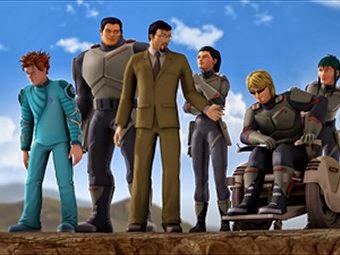
Once in a while Netflix completely surprises me and shows me something that I really like. In this case, it’s the animated superhero show The 99. The 99 is a 26-episode series written by Dr. Naif Al-Mutawa, that focuses on a group of heroes who are powered by magical gems called Noor stones. Supposedly, there are 99 stones. Each stone grants it’s user different powers. The first one to be found is a paraplegic man with the power to send out pain waves/healing waves from his hands: John Weller.

   The others found all have different abilities and powers, and all have Arabic names given to them once they join the 99. I suspect it has to do with the 99 names of Allah…well, and 99 Noor stones. Of course, I myself am an Agnostic, but I love discussing multiculturalism! As for the superheroes: There is (mainly) Jabbar The Powerful, (Superstrength and invulnerability) Darr The Afflicter (John), Mumita The Destroyer (Superstrength and agility.) Noora, The Light, (Light-based  powers and  empathy.) Jami The Assembler (Super engineer.) Those are the main three from what I see. Although the series plays off of Islam, the show itself is more about universal values of good and evil, and happens all around the world (Hong Kong, St. Louis, Hungary, and Jakarta, to name a few…) just  like the X-men and the mutants.
     
Dr. Ramzi Razem serves as the mentor (The Professor X, if you will.) of The 99. One thing I liked about the show was how well it depicts in my mind, how people would react to being superheroes. John doesn’t just get on a plane and fly off with them! No! He tells them to get out of his house and go away until his powers go out of control and they chase him down! Although John is a little bitter in the beginning, and generally has a negative view of his chair (Except when The 99 upgrade it into a sort of armored Permobil powerchair!) I tend to think that’s due to his tough-as-nails persona and background, rather than pity.

    In fact, I have to say, for all it’s cheesiness, I really liked The 99’s depiction of John’s disability. He sort of moves extra-consciously…with a click before he moves from his powerchair of course. And although I never realized it…that’s how I move too. I sort of have to think “Okay, turn here; then straight ahead.” but of course it’s all habit. Early episodes have some nice examples of John’s POV, all punctuated with clicks from his chair. Little things like this I notice. I’m always somewhat pleased when I see disability in mainstream superhero media!

     Of course, opposite Ramzi and The 99 is Raghul. Raghul is the Magneto to The 99’s X-men. A nice plot twist occurs when John becomes suspicious of why Ramzi brought them to The 99 Mansion, and gave them codenames. Why do superheroes need secret identities, anyway? (I know, to protect their loved ones.) It turns out that they had been working for Raghul, and the man they were told was Raghul was Ramzi! Nice twist on the secret identity theme. Anyway, Ramzi reasons that since they already have codenames and a secret base, he might as well use them for Good.

     The base of The 99 is in Selville, Spain, on the ruins of a 13th century Islamic library. I like how the show is based in Arabic/Islamic mythology and culture, and explores themes of ethics, social justice, and multiculturalism, in much the same way as X-men does…but just as X-men is not specific to any religion…The 99 has a different cultural/historical setting which adds to the backgrounds of the characters and Good vs. Evil narrative of the show.

Though Islamic culture is important to the show, the religion is never explicitly  discussed. Though I felt like maybe it’s time we have strong Islamic superheroes? I felt like it was a missed opportunity. It’s time we had a serious intercultural dialogue in that respect. If Nightcrawler can discuss Christianity, why not John Weller discuss Islam? Though I really like that the show went for (to me.) something new, to show how people act on cultural values; and for including a bit of disability culture as well.

The only thing I didn’t like about this series was…the animation. Until Beware The Batman proved me wrong, I’ve always kinda thought 3D animation was inherently clunky and awkward…and it’s still pretty bad here. Often, it feels more like a product of the late 90s than modern animation…but the action and themes covered are good, even though animation is lacking! If you’re looking for more disabled superheroes, or just a new show to watch about superheroes, I highly recommend The 99 for its cultural settings, sneaky plot twists, and cool superheroes! I’d rate this 3.5/5 stars, but just for animation issues! Give it a watch! I was pleasantly surprised!