Showing posts with label intercultural communication. Show all posts

Saturday, February 28, 2026

Emi Ibarazaki and Social Penetration Theory:

Emi and Social Penetration Theory

Intro: As mentioned earlier, Emi aligns with Social Penetration Theory, which asserts that as relationships develop, communication moves from superficial topics toward increasingly intimate disclosure. Interaction gradually penetrates the communicators’ public personas to reach their core sense of self.

EMI (SOCIAL PENETRATION THEORY):

If Shizune’s route is structured around influence, Emi’s is structured around layers.

Social Penetration Theory visualizes personality as layered:

  • Outer layer: surface traits, routines, public persona
  • Middle layer: emotional patterns, guarded vulnerability
  • Core: trauma, identity, unresolved grief

Emi’s route maps almost directly onto this model.

Outer Layer: Energy, Routine, Accessibility

“I like running. It’s what I do.”

“You’re coming running with me tomorrow, right?”

Her communication is playful, energetic, routine-based, and forward-looking. Morning runs become the foundation of their relationship. They share time, jokes, and light teasing.

This reflects high breadth but low depth. They talk often. They spend time together. But the conversation avoids emotional gravity.

“They’re just legs. It’s not a big deal.”

Even when discussing her prosthetics, she keeps it surface-level. The statement minimizes depth and redirects focus away from trauma and toward functionality.

Emi’s outer layer is transparent but controlled.

Middle Layer: Selective Vulnerability

As intimacy increases, emotional friction appears. Hisao begins asking questions about her accident and her father. Emi responds with deflection:

“Why does it matter?”

“It was a long time ago. I’m fine.”

These are penetration barriers. She is not hostile; she is protective.

Social Penetration Theory emphasizes reciprocity. Hisao opens up about his heart condition and allows emotional depth. Emi does not fully reciprocate.

“Running helps me not think about stuff.”

This line is pivotal. It acknowledges “stuff” without naming it. The middle layer is partially visible but sealed.

Physical Intimacy and Emotional Asymmetry

Physical intimacy develops before full emotional disclosure. Emi allows closeness physically, yet resists emotional excavation.

“Don’t make this into something it’s not.”

This reveals asymmetrical penetration:

  • Physical layer: accessible
  • Emotional trauma layer: restricted

Intimacy does not progress evenly across all dimensions. Emi controls the rate and direction of access.

Core Layer: Grief and Emotional Avoidance

The emotional climax forces confrontation with her core. When Hisao pushes too forcefully, conflict emerges. The core contains her father’s death, the accident, and fear of stagnation.

“If I stop moving, I have to think about it.”

Running is not just athleticism. It is emotional containment. Greater intimacy requires risk. For Emi, that risk is reliving loss.

The Rift: Premature Penetration

In the negative trajectory, Hisao presses too hard. Emi withdraws emotionally. Penetration without consent produces retreat. Depth must be mutual.

Resolution: Voluntary Core Disclosure (Good Ending)

In the good ending, disclosure becomes voluntary rather than extracted.

“I don’t want to keep running away.”

This marks full-layer access. She allows Hisao to witness her grief without deflection.

The communication dynamic shifts from activity-based connection to emotion-based transparency. Disclosure becomes reciprocal rather than forced.

Summary

Within Katawa Shoujo, Emi’s route exemplifies Social Penetration Theory through:

  • High-breadth, low-depth beginnings
  • Controlled vulnerability
  • Conflict caused by premature emotional pressure
  • Resolution through voluntary, reciprocal core sharing

Emi does not resist intimacy itself. She resists losing control over how intimacy unfolds.

Thursday, February 26, 2026

Shizune / Misha and Social Influence Theory (2026):

Intro: As established earlier, Shizune and Misha align with Social Influence Theory, which argues that relationships develop as a result of change in belief, attitude, or behavior caused by another person’s actions. Power is the potential to produce that change.

SHIZUNE / MISHA (SOCIAL INFLUENCE THEORY):

Shizune represents coercive and structural force.
Misha represents legitimacy and normative reinforcement.

On Festivals / Life (Misha translating for Shizune):

"Human beings evolve with each new generation! The ideals and beliefs behind a festival will inevitably change with time! Now, it's about delicious fried food and amusing little games that you play to win prizes! Hahahaha!"

This statement reframes tradition as adaptive behavior. Festivals are not sacred constants; they are evolving systems shaped by participation.

That mirrors Shizune’s approach to relationships and institutions:

  • Meaning follows engagement.
  • Structure sustains participation.
  • Ideals shift, but activity remains.

Misha’s enthusiastic delivery normalizes the philosophy. Shizune supplies the framework; Misha supplies social accessibility.

On Decision Making (Shizune):

"We are going to play for it... The oldest game known to man, upon which the fate of nations has been known to rest: Rock, Paper, Scissors."

For Shizune, decisions are rarely casual. Even minor disagreements are formalized into competitive systems.

Rock, Paper, Scissors functions as:

  • A procedural equalizer
  • A depersonalized method of conflict resolution
  • A ritualized distribution of power

This preference for structured competition extends beyond isolated scenes.

Shizune:

  • Has mastered snapping loudly despite being deaf; an intentional physical assertion of presence and control over attention. She has one of the “loudest” characters act as voice (Misha).
  • Prefers strategic board games such as Risk, where territorial dominance and calculated expansion determine success.
  • Turns even leisure activities, like a fishing trip, into competitive metrics of performance.

Competition is not incidental to her personality; it is her communication mode. Rather than negotiate emotionally, she negotiates through systems. Influence becomes measurable: who wins, who adapts, who participates.

In Social Power terms, this reflects:

  • Legitimate power (Student Council authority)
  • Coercive power (pressure through structured expectation)
  • Reward power (approval, inclusion, status)

The snapping is particularly notable. Despite being deaf, she ensures auditory impact. That act demonstrates that influence is not diminished by disability. She asserts control over the communicative environment in ways that compensate rather than retreat.

On Friendship (Shizune):

"I forgot that the whole time, Misha was there, opening up to me, and giving a hundred percent everyday. I missed what I was looking for, because it was in plain sight."

This line identifies the limits of influence when it is overly systematized.

Misha’s role is relational reinforcement:

  • She softens directives.
  • She amplifies enthusiasm.
  • She legitimizes participation socially.

Where Shizune creates structure, Misha creates atmosphere.

From a Social Influence perspective, Misha embodies referent power, which is compliance gained through warmth and identification. Her legitimacy makes Shizune’s more coercive directives sustainable.

When Shizune overlooks that relational labor, it highlights a distinction:
Influencing behavior is not the same as recognizing contribution (participation; creating a rift).

On Friendship (General):

"The world would be a different place without you or me but who else would realize it?"

This line reinforces a central concept of Social Influence Theory: influence is often incremental and unnoticed in real time.

Daily behavioral adjustments accumulate:

  • Schedules change.
  • Habits shift.
  • Expectations recalibrate.

In the good ending, we have increased participation and contribution from Shizune and Misha through Hisao.

Shizune alters environments and structures.
Misha alters tone and perception.

Monday, February 23, 2026

COMMUNICATION THEORY IN KATAWA SHOUJO (2015):

COMMUNICATION THEORY IN KATAWA SHOUJO (2015):

Intro: I originally had bunch of Comm. notes after I 100%'d Katawa Shoujo back in 2015. These are just some of the "raw" notes I took. Without essay form. The essay can be found here, as can my other Katawa Shoujo analyses.

COMMUNICATION THEORY IN KATAWA SHOUJO:

Rin (Redefinition Theory): States that in communication with ablebodied persons and among themselves, disabled persons engage in a process whereby they critique the prevailing stereotypes held by the ablebodied and create new definitions.

Emi (Social Penetration Theory): Asserts that as relationships develop, persons’ communication changes from superficial to deeply personal topics, slowing penetrating the communicators' public persona to reach their core personality or sense of self.

Shizune / Misha (Social Influence Theory: Argues that relationships develop as a result of 'change in the belief, attitude, or behavior of a person (the target of influence), which results from the action of another person (an influencing agent)', and social power as the potential for such influence. (Update: I should probably write more on this and how Shizune represents coercive force/Misha represents legitimacy. More on this later.)

Hanako (Uncertainty Reduction Theory): Posits that when interacting, people need information about the other party in order to reduce their uncertainty. In gaining this information people are able to predict the other's behavior and resulting actions, all of which according to the theory is crucial in the development of any relationship.

Lilly (Principled Negotiation Theory): Argues that a good agreement is one which is wise and efficient, and which improves the parties' relationship. Wise agreements satisfy the parties' interests and are fair and lasting. The goal is to develop a method for reaching good agreements.

Hisao Represents The Stages of Culture Shock:

CH. 1:

Preliminary Phase

Marked by rising sense of anticipation tempered by regret of leaving.

Spectator Phase

Passive but alert spectator, marked by intensity of emotion that careens erratically; ends when passive stance is no longer possible

CH. 2: (Story/adaptation theory chosen)

Increasing Participation Phase.

Greatest variation from persons to person; after (characteristically) clash of values, questions arise: Are values arbitrary? A fabrication? Natural to one’s own culture?

CH. 3: (Bad endings stop here.)

Shock Phase.

Strikes people who have had some success in first efforts at adaptation; manifests as paranoia, fear, self-consciousness, intense judgments of others based on ethnocentric criteria; could precipitate departure.

CH. 4: (If good/neutral ending)

Adaptation Phase.

Sense of being foreign no longer exists; language and thinking are simultaneous—being both in and out of the culture at the same time.

Update: So, one can apply communication models to everyday circumstances, even in games/narratives where they might not be as explicit, but reveal themselves through cultural patterns and actions. I hope you've enjoyed these notes as much as I enjoyed writing them back then.

Saturday, March 15, 2025

Communication Theories in Katawa Shoujo:

Communication Theories in Katawa Shoujo:

Katawa Shoujo is a visual novel game about a high school boy named Hisao Nakai in Japan. After developing a heart condition (arrhythmia), he’s transferred to Yamaku Academy, a school for students with disabilities. As he adjusts to his new life, Hisao meets five girls, each with their own experiences of disability and unique way of communicating. Through these relationships, Hisao not only explores romance but also learns to adapt to disability culture — and each girl’s story represents a different communication theory that helps him do so. The player also meets Kenji, a paranoid, legally blind student who lives across the hall. Though his over-the-top conspiracy theories and isolation from the rest of Yamaku make him an unforgettable character, his story ends early and doesn’t follow the same structure as the others. Because of that, while he deserves a mention, he won’t be discussed in detail here.

The game’s story structure follows a pattern of culture shock. Hisao leaves behind his old way of life and enters disability culture at Yamaku. “Only after I stand in front of the haughty main building, I surprise myself by realizing why the gate bothered me: it was my last chance to turn back, even if I had no life I could ever return to.”

Dr. Igor Klyukanov outlines five stages of culture shock in Principles of Intercultural Communication, which we can see reflected in Katawa Shoujo:

1. Preliminary and Spectator Phase – Hisao’s early days at Yamaku, where he passively observes the new environment but doesn’t yet understand it. He wonders if he will ever have a “normal” life again.

2. Increasing Participation Phase – As he interacts with the students, he starts questioning his old perspectives. He wonders, “Will I ever get used to sights such as this?” and, “Is this what passes for normal around here?”

3. Shock Phase – A turning point in Hisao’s journey, depending on the route taken. This is the emotional crisis where he must either accept his new reality or struggle against it.

4. Adaptation Phase – If he successfully navigates the shock, he reaches a point where disability is no longer foreign. He is able to exist in and out of the culture at the same time, accepting both his past and present selves.

Each girl Hisao meets serves as a guide, embodying a different communication theory that helps him through this adaptation process.

Shizune and Misha – Social Influence Theory

Shizune, a strong-willed deaf student and class representative, communicates through her interpreter, Misha. Misha’s loud, bubbly personality contrasts with Shizune’s serious and competitive nature, creating a comedic yet dynamic relationship between the three. Their story aligns with Social Influence Theory (French and Raven, 1959), which suggests that relationships develop through shifts in power, influence, and persuasion. From the start, Shizune wants to draw Hisao into her world, challenging him through student council work and games. She believes: “The mark of great people is that they are daring and can follow through.” She wants to make Hisao stronger by encouraging him to take on leadership roles. In her good ending, Hisao embraces this influence, realizing that Shizune was never trying to control him—she just wanted to connect. In her bad ending, the power dynamic collapses. When Hisao and Misha’s hidden relationship is exposed, Shizune loses trust in both, and Hisao becomes isolated. Since Shizune views love and life as all-or-nothing competitions, there is no neutral ending.

Hanako – Uncertainty Reduction Theory

Hanako, a shy burn victim who avoids attention, struggles with social anxiety and self-worth. Her story follows Uncertainty Reduction Theory (Berger and Calabrese, 1975), which states that as people interact, they seek to reduce uncertainty about one another. When successful, this leads to increased intimacy and trust. At first, Hanako barely speaks to Hisao, often relying on her best friend, Lilly, for comfort. But as Hisao shares his own struggles, she begins reciprocating. “I-I have to,” she says when explaining her past, indicating her need to balance the information she’s given and received. In her good ending, she fully opens up, allowing Hisao to see her scars and returning his affection. In her neutral ending, they remain stagnant, both agreeing to “stay the same,” preventing further connection. In her bad ending, she retreats completely, rejecting Hisao in a final outburst: “I hate Lilly! I hate you most of all! I know I’m broken!”—a full breakdown in uncertainty reduction.

Lilly – Principled Negotiation Theory

Lilly, a blind and kind-hearted girl, navigates relationships with a sense of fairness and compromise, making her story fit Principled Negotiation Theory (Ury and Fisher, 1981). This theory emphasizes agreements that satisfy both parties’ interests in a balanced, lasting way. Unlike Shizune, who views conflict as a challenge, Lilly avoids unnecessary confrontation, focusing on harmony. She even accommodates Shizune, her rival, saying, “Please, Hisao, it’s alright,” when he tries to defend her. In her good ending, Lilly stays in Japan, choosing her relationship with Hisao over moving to Scotland. The agreement is fair and mutual. In her neutral ending, she leaves, but encourages Hisao to follow his own dreams, showing wisdom but forfeiting their relationship. Because she has an older sister to care for her, she has no bad ending.

Rin – Redefinition Theory

Rin, an eccentric painter born without arms, often struggles to express herself. Her story follows Redefinition Theory (Braithwaite, 1990), which argues that people with disabilities challenge societal definitions and create new identities for themselves. Rin doesn’t see herself as limited: “I don’t think I’m that disabled. I mean, I do pretty much everything differently. But it’s not that hard. I can always practice.” She adapts effortlessly, seeing disability as a part of her identity rather than a restriction. Hisao, however, initially struggles to understand her. When he tries to “fix” her or make sense of her abstract thoughts, their relationship fractures. “I think in the end, I’m not really happy with who I am, either. But that doesn’t mean that I regret being who I am. That’s the thing that’s wrong with you, Hisao.” In her good ending, Hisao accepts that Rin doesn’t need fixing, and their relationship becomes one of mutual understanding. In her neutral and bad endings, he fails to see her as she is, causing her to withdraw completely.

Conclusion

Katawa Shoujo is more than just a dating sim. It’s ultimately about Hisao’s journey of adaptation and self-discovery within disability culture. Each girl represents a communication theory that helps him move through the phases of culture shock, from uncertainty to acceptance. Through these experiences, Hisao—and by extension, the player—comes to see disability not as an obstacle, but simply another way of being.

Bibliography

Berger, C.R., and Calabrese, R.J. (1975). Some explorations in initial interaction and beyond: Toward a developmental theory of interpersonal communication. Human Communication Research, 1(2), 99-112.

Braithwaite, D.O. (1990). From the Margins to the Center: An Intercultural Redefinition of Disability. Text and Performance Quarterly, 10(1), 7-21.

French, J.R.P., and Raven, B. (1959). The bases of social power. In Cartwright, D. (Ed.), Studies in Social Power. Ann Arbor, MI: Institute for Social Research.

Klyukanov, I. (2005). Principles of Intercultural Communication. Boston: Pearson.

Ury, W., and Fisher, R. (1981). Getting to Yes: Negotiating Agreement Without Giving In. New York: Penguin Books.

Thursday, June 5, 2014

THE CAT RETURNS (2002) REVIEW:


THE CAT RETURNS (2002) REVIEW:

 “If you find yourself troubled by something mysterious or a problem that's had to solve, there's a place you can go where you always find help. You just need to look for it.”

- The Baron

What if I told you that Anne Hathaway was actually a catgirl before she became Catwoman? In The Cat Returns, Hathaway plays a schoolgirl named Haru, who is whisked away to The Cat Kingdom after she saves a cat who is actually The Cat Prince. Stan Girl gets lost in magical king while she’s in the Cat Kingdom, she finds out she’s becoming a cat, and is set to marry The Cat Prince!

There’s sort of a Standard Studio Ghibli plot. Girl gets lost in magical kingdom then reclaims her identity (Like Spirited Away, with cats!), and comes back to the real world. I have to say though, it’s beautiful, and the human-like cats make me laugh! I dunno, maybe I just like to laugh at really fat cats. Either way, it is magical, and a beauty to behold!

You see, like most Studio Ghibli films, the character designs and animation are where this film really shines. She is guided to the Cat Kingdom by a charming top-hatted cat from The Cat Bureau, The Baron (AKA: Baron Humpert von Gikkingen, played by Cary Elwes.) A statuette of a raven by the name of Toto also assists  her, as well as a fat cat Muta. All the cats start walking in the cat world. But, as soon as she enters the cat world, the fat, mustachioed Cat King seems determined to marry her to The Prince. Let the cat chase begin!

In addition to being a wild cat chase, Haru has to escape from The Cat King and stop transforming into a cat. So, it’s kind of like Kafka mixed with LOLcats, visually inspired by Alice in Wonderland! It’s great fun, has fantastic designs, and even swordfights! Talk about adventure! All to stop being chased by cats! And just when she thought she was having fun!

There’s a good lesson here. Sometimes imagination is good, but if it runs wild, it can become scary! What starts off as a playful romp through the Cat Kingdom twists into Haru almost becoming a cat! But, as The Baron says, you can always ask for help! A fun movie, with plenty of surprises and enough eye candy to satisfy even the grumpiest of cats! (Or people!) If you have time, and like fantasy and anime, definitely give this one a watch!

 Anyway, I’ll give it 4/5, but maybe I’m just really soft on Studio Ghibli! They have a way of infusing even the characters mundane life with such life and detail, that I was drawn in immediately! Of course, Haru’s mundane school life serves to highlight the strangeness of seeing walking-talking cats! And puts you in her shoes, confused amid a fantastical world full of cat-astrophe! Okay, I couldn’t resist! Great comedy, good story, great animation… it’s nearly purrfect! (Last cat joke, I promise!) Highly recommended!


Saturday, March 15, 2014

March 8 2014: VSA Day of Arts For All

                                         Janine Moore's "Orange Groves", 1st Place Emerging Artist


                                                     Henry Hess’s “No Place Like Home”

               (Spartan meets Pyramid Head” by Jonah Farmer.)

If you follow my blog, you know I usually go to The Day of Arts for All on March 8, to report on it. But this year, I was even in it! My piece was called “Pig Head”, which used bright colors and saturation to illustrate a pig head via digital art. Aside from art, there was also some music by Sarah Bellish, a young soloist who uses her experience with disability to write music. A great opportunity to listen to some of the great life experience disability brings, in a soulful way! There were also videos meant to illustrate the experience of disability. The theme of the day seemed  to be representing these perceptive  personal experiences.

 Then the awards came. All who participated got an award. Including me! All the pieces were great, but the two I liked best were Henry Hess’s “No Place Like Home”, showing Dorothy’s ruby slippers, which won third place in the Youth Artist category. 2nd Place in the same category went to a Halo/Silent Hill inspired piece! “Spartan meets Pyramid Head” by Jonah Farmer. 1st place in the same category went to Nathaniel Curtiss of Worthington for Where Miles Davis Recorded The Birth of Cool! A super cool use of perspective! Best in Show was called: “Beautiful Nature Life: Where Everyone Would Like to Be”, a mixed media piece by the team of Wendi Olszewski, Shawnda Osswald, and Stephanie Spencer, depicting a brightly colored rural life.

But, everyone wins in my book, because we all told our stories through art: “Why the pig head?” Someone asked me in front of my piece. “Why not?” I said. The point for me is just to create something that didn’t exist before. The image that jumped out at me in the framework of my color scheme was a pig head. I’m interested in seeing how my mind and experience as a disabled person translates to my creations, as each
artist did through their own perspective. By his/her own experience.

Going back to perspectives, the films Be My Brother is an Australian short film about a man with Down Syndrome who records everything he observes, but he cannot get his brother to record something on the bench with him. He displays a dazzling intelligence, quoting everything from Shakespeare to The Lion King, and even charms a woman who he describes as the “most attractive woman in the world”. The film ends on a bus, with his brother hugging him.    

Sensory Overload is a film from the perspective of an autistic. As such, there is intermittent sound, and sometimes it becomes increasing overwhelming. From the blaring of city sirens to a cashier tapping a pen in a café. Wild colors add to the disorientation, and autistic perspective. The film ends in silence as a woman helps the boy pick up papers he lost from his backpack.

We ended with a comedy called Jazz Hand. In this a Californian woman with a prosthetic hand enters a dance audition. While tap dancing, her hand falls off and the choreographer recoils in exaggerated disgust. She puts her hand back on! But backwards! Lots of big laughs from this one, and nice to see a “disability movie” that is a comedy. “Do you think he noticed?” Asks the dancer. Duh! Yes!

I’m pleased to have been a part of The Day of Arts for all. It was a fun time, and I got to get my art out and look and other people’s art! That’s always a good day for me when I can get positive messages about disability! We are all capable of becoming more than we appear to be. Thanks, VSA! I had a great time.
For a full list of Day of Arts for All winners visit VSA's website: www.vsao.org

                                                     ("Pig Head" by Chris Bowsman.)
                               

Thursday, October 17, 2013

Planet of Snail (2012)

PLANET OF SNAIL (2012)


 Young-Chan Cho: “All the deaf and blind people have the heart of an astronaut.”

Planet of Snail is a documentary from South Korea. It is very slow-paced and plays with minimal sound to simulate Young-Chan reliance on tactile communication and finger taps as opposed to always using voice. His voice, one might say is the lack of sound. The story follows him along with his wife Soon-Ho. Soon-Ho has a disability caused by degeneration of the spine.

Together the film explores their mutual dependency and quiet, slow lives. The reference to Young-Chan Cho as an astronaut in the Planet of Snail is interesting because I too consider myself an alien. Some things that an able-bodied person can do very easily, I can’t. But, I think from that I gained a desire to explain my worldview. For Young-Chan Cho, it’s the same. On one hand, he talks about his disability as no different than fading memory for a sighted person. When you remember something with sight, it’s never as clear as it was when you saw it the first time. A very insightful critique of sightedness!

    On the other hand, Young-Chan’s poetry reveals a deep understanding of how his life is alien. “What I see in front of me is my reality.” He says. “I am deaf-blind even in my dreams.” In spite of this determination, he encounters obstacles very early on in the film. While taking a Hebrew exam, Young-Chan’s professor says that he had the words in the right order, but his assistant transcribed it wrong. That is, his wife, not his assistant. But, he gets an A+!

    Later in the film, we see Young-Chan eating with friends, who look as though they may be deaf-blind as well. They get into an argument about why he married, and the other friend believes he may never marry. Much of this argument is done through tactile communication and finger tapping. I don’t know Korean sign language, and only understand little bits of American Sign Language, but the finger tapping to me seemed vital to understanding the language. Young-Chan’s friend believes he married Soon-Ho to be a live-in caretaker, which Young-Chan Cho denies, but seems shaken by.

   Through his friend, we see his clay crafts, including a mug shaped like a naked man. Young-Chan explains that he didn’t like that one very much. Soon-Ho says that sometimes he takes care of her, because sometimes her pain is so bad that she can’t even pick up the phone. “I couldn’t even say hello. I could only make screeching sounds.” She says. Nonetheless, we see Soon-Ho helping Young-Chan around the house more often than vice versa: Fixing a light, helping with food, walking on the beach, even helping to organize Cho’s play with his friends.

     The film ends with a solo trip to a doctor's appointment, where he admits he was scared to be without his companion. “I felt colder.” He says.  Then, Young-Chan Cho goes swimming, where he says he can open his eyes and see a different world. (As opposed to The Planet of Snail.) In closing, he says he's only waiting to see the most precious things. He and I have much in common. We are both astronauts; we both use words to paint our lived experiences with disability; we have many of the same fears. What will happen to me when my friends and caretakers are gone? The film explores these fears, which at times seem to contradict his coping mechanisms…art and poetry which transcends his body.

    The film is very slow-paced, but there was enough going on that intrigued me that I never lost interest. I love movies about disability experiences, other planets, and other cultures and ways of life. I identified with the main character; but only insofar as he uses art to overcome his disability, such as I try to do. The rest was new to me: The finger tapping, Young-Chan Cho’s beautiful descriptions of his disability in poetry, having a partner vs. having friends, and negotiating each other’s disability. These were all wonderfully new to me. The slow pace also helped me drink in Young-Chan's world.

     I found Planet of Snail to be a fun, dramatic and captivating experience… it is not  just internationally appealing to me, being a Korean film, but it is interculturally appealing too. I mean, I related my experiences with disability with Young-Chan They didn’t always match up. For example, in my dreams, I'm able-bodied, though it by no means is a reflection of de-valuing my life with a disability...I can simply do more in my dreams. Also, Young-Chan says sometimes he knows he’s being stared at. I would tend not to focus on it…nonetheless, I do know it probably is happening.

Anyway, this is a great film that explores many themes about disability and relationships, and the role of art as a tool for life. Highly recommended…I’d say 4/5 stars: the slow pace might be off-putting to some, but in my case, it helped me catch details like the finger tapping as communication. A wonderful film! Go see it!


Friday, October 11, 2013

THE END OF EVANGELION: THE NEON GENESIS EVANGELION MOVIE (1997)

THE END OF EVANGELION: THE NEON GENESIS EVANGELION MOVIE (1997)

“Reality can be painful. But, it’s something you have to accept.”

- Kitsuragi


    Right off the bat, this “movie” is a little weird. I don’t remember that Asuka ended up wounded from the battle with the last Angel…but the movie starts with her in a hospital bed. Fair enough. Maybe something happened in-between. But, that doesn’t matter anyway, because NERV gets attacked by hijacked EVAs. Not the Angels, because theoretically they‘re defeated! Meanwhile, Asuka’s death puts Shinji in doubt again, and right when they need him to connect to his giant robot to kick butt, he “can’t do it.”

In general, I find that anime movies made from series tend to be weak, because they reset most of the character development, However, in this case, at least it progresses the story, and gets rid of the final villains…it takes the form of 4 episodes, effectively becoming extensions to a series that could’ve ended 10 years earlier, no muss no fuss. But, the villains are using EVAs to back Angels to restart mankind. Plus, at least Shinji has Asuka’s death to push him back into doubt. It makes sense, but is no less annoying. Kitsuragi and the rest of NERV fend off the terrorists, but still Shinji won’t pilot the EVA, and needs a pep talk.

I wouldn’t think that Shinji would have a choice. But, here’s where things get a little crazy. Kitsuragi gets shot and dies in front of Pen-Pen, the lovable cyber penguin, just after she gives her talk. And it turns out Asuka wasn’t dead, and that she was being visited by the spirit of her dead (German, remember!) mother which activates her EVA. She fights the rest of the EVAs alone while Bach plays in the background. It is glorious, and the best scene in the movie…not only because it’s the only straightforward action scene, but because it’s Asuka!

 Shinji’s father reveals that he was working with the Angels, and Rei (The 3rd pilot, remember!) tells him she won’t participate, but nonetheless she ascends a staircase to this weird looking giant Robojesus on a cross and becomes a giant spirit, an angel herself. Here’s where it gets weird. Rei approaches Shinji and asks if he wants to restart the Earth, and becomes blended physically to Shinji. The rest of the movie is Shinji reasserting his individuality.

So, it turns out that Shinji/Rei did destroy the Earth, but by choosing to be an individual…he saved it. Or re-created it? Is it recreated just how he remembers it? Does everyone continue on like before? What just happened? Doesn’t that invalidate the entire movie? So many plotholes to restarting timelines…wouldn’t Asuka still be dying in a hospital?

Overall, I liked this movie, but only because I get to see those characters from Neon Genesis Evangelion again. Though two out of three characters are in their worst philosophical forms. A siege is no time for philosophy. I mean,  Evangelion had comedic moments, but is mostly action. But, you wouldn’t know it from this movie. I gotta give them credit though. One of the show’s main supporters, Sega, was on the brink of oblivion at the time. By 2001, they’d cease to develop hardware.

Hey, I’m always up for some philosophy…it just happens in awkward places throughout the episodes. The siege of NERV; Rei becoming an Angel; right before Shinji needs to defeat the last Angel, Asuka! Some of the manipulation of Christian imagery is nice, as well as German classical music during Asuka’s battle scenes. And yet, the message is slightly contradictory and detracts from the mind-blowing revelations of the series. Face reality…from a giant robot! On second thought…never change, Evangelion! 3 out of 5 stars for this one, despite a rocky start and tragic ending. Oh, and feel free to discuss the ending in the comments!


Monday, October 7, 2013

ReelAbilities Columbus 2013:

ReelAbilities Columbus 2013:


When I went to Reelabilities 2013 this weekend, the first movie I saw was “Aphasia”, in the McConnell Arts Center. It’s an American film (2011) about Carl McIntyre, an actor and salesman who has a stroke, and suffers from aphasia, the inability to read, write, or understand spoken language. The film follows his year and a half trying to regain these skills. It’s a very comedic film, but not without it’s touching moments, such as when Carl first suffers the stroke, his kids jump on him and his wife yells at him to get up and stop messing around.
   
Also, the film shows Carl’s frustration of having to learn words again. Oddly, the first words he seems to learn quickly are curse words, which is sometimes played for comedic effect. (They must be stored in a different part of the brain…or linked to his frustration.) Such as when he goes to a fast food joint and tries to order a “Frozee”, but ends up seeming to order…something else! He also has trouble distinguishing between yes and no at first, which means he ends up with much larger orders sometimes and says yes when he means no.

    In his therapy,  he begins to show “cognitive flexibility” which is why he can relearn words by getting around to them in his brain. For example to say “when” Carl at first has to say “Chicken” which surprises his therapist. “Chicken?” she asks. Then, Carl says “Chicken! Eggs! Hen! Www-when!” The surprising thing for me was how much I empathized with Carl’s aphasia. Having learnt another language (And sometimes having difficulty with my own…but haven‘t we all had those?), it’s frustrating when you can’t convey what you want, and embarrassing when you say something completely different.

     This is a short film, 40 minutes long, that embraces the entire gambit of human emotions, and the human struggle to adapt to worlds which we don’t understand. Ultimately, Carl realizes when he’s watching himself on TV that: “There are two mes. The then and the now. And the now me is the only version of me this little boy [his son] will ever know.” And spoiler alert: He does finally get that Frozee!

   This is a great film for anyone who has struggled to communicate. Or likes to laugh. Funny story: as I came into the theater, people there must’ve thought I was with the Dancing Wheels, a disabled dance group that was there earlier that evening. They showed me into the theater, and then I got on this big metal lift, and I almost ended up on stage. I didn’t know! I thought it was just really good handicapped seating! But, then I told them I wasn’t a dancer, and they took me back down into the audience. Communication breakdown even between non-aphasiacs!

     The second day was when I saw “Renn Wenn Du Kannst” and “Yo Tambien” in the Wexner Center. These were the two films I’d planned to see originally. “Yo Tambien” (Me too.) is about a man called Daniel with Down Syndrome who falls in love with his able-bodied coworker Laura in Seville’s Department of Disability Services. Daniel is wonderfully arrticulate, and discusses philosophy, and art, and his disability with her. Laura is more of a “wild child” who has a dislike for rules, and is new in town, so Daniel is her first connection.

     However, just as Daniel is Laura’s first connection as a friend, Laura is taught how to love again by Daniel’s example. There are hints that Laura was abused as a child, and is estranged by her family. Likewise, Daniel’s mother can be a little to overprotective of him, and thinks he’s somehow being taken advantage of. Daniel also has a friend, Pedro, a dancer, who falls in love with a woman with Down Syndrome in his dance class. This serves to show how the concept of normative relationships doesn’t always function correctly.

    In both cases, it is the able-bodied people who do not approve of the relationships. But, they don’t want or need their approval. In Daniel’s case, people think he’s being bamboozled. In Pedro’s case, people think: He has Down Syndrome, how can he know what love (or sex!) is? These are the kind of presumptions the disability community has to work against! It’s not able-bodied vs. disabled. We need more stories like this that show us that. Also, it did remind me a lot of my trip to Spain, as I suspected it would. The fast, colorful language, the classical architecture and wild countryside, and Daniel’s family was always drinking wine. What a great Spanish presentation of the Independent Living and Disability Rights movements!  

    Now on to Renn Wenn Du Kannst (Run If You Can)! This film is from Germany, and follows Ben, a quadraplegic about to complete his MA (Boy, I’ve been there!) who falls for one of his assistants friends, a woman who plays cello, but has crippling stage fright to where she can only perform solo. Now, here’s what I thought was cool: In the opening scene, Ben in ordering his assistant around and cleaning up his apartment, but the moment his aide leaves, his thesis which he just PRINTED, flies out the window. I nearly cursed at loud as Ben does!

    You see, when Annika (His aide/Ben’s love interest, in a sort of love triangle!) has stage fright, she can run away, as she does many times during performances in the movie. Ben can’t run away from his fear which is that he will no longer be able to maintain relationships after his accident. Indeed, in the course of the movie, Ben kind of laughs off the notion that Annika could possibly love him. But, then of course, she does, but neither find that they can perform sexually under the weight of their traumas.

    Ben’s story is that he was in an auto accident that killed his disabled girlfriend as well as left him quadriplegic. Since then, he has developing a joking attitude (He calls his attendant Christian…Nurse Christiane!) and stays away from people, since he can’t run from his fear. As Ben jokes with Christian: “I was not put on Earth to have sex with women. I was put here to look at their backsides.” I must admit, I often take myself out of the game so to speak, before I even know if I’ll succeed. For many of the same reasons; and the fact that it was in German made it hit home closer for me.

    The film wonderfully juxtaposes the need for order (Classical music; cleaning the apartment; the Master’s thesis.) against fear and non-logical impulses. Though all three in the end remain friends, it is left unclear whether they will go their own separate ways. There is a small scene where Ben’s mom comes to visit, and she starts cleaning and Ben tells her to get out! That to me was pretty powerful, as a cultural analyst. This is Ben’s territory! Only he and his aides can order it!

     And hey, as a non-native German-speaker I learned a few new slang words! As usual the European scenery was great…but in a different way than Spain’s. The city of Bottrop, as presented here is large and modern, dominated by high-rises and steel. Actually, Ben climbs the Bottrop Tetrahedron and sits on top of it. Something he told “Christiane” was his “unattainable dream”. A wonderful film dealing with interability relationships…but certainly not as afraid to dive into pain as Yo Tambien. Yo Tambien was more colorful; more Spanish…for lack of a better adjective!

     Afterwards, a speaker read her academic paper on the presence of able-bodied/disabled actors in the media. And even gave some cursory background into the disability rights movement in Germany…by commenting that Germany’s movement is based on “self-determination” (Which she never called by the German Selbstbestimmung.)

   The trouble is, in the USA, it seems to be based on “Independence”. So, whatever differences both movements have based on those words are (to me.) completely rhetorical. I don’t get the difference…but the main argument seemed to be that media presence within the “community” is growing. This year was the opposite of last year’s for me: I came prepared to speak this time, but never quite got the opportunity to ask questions!
 
   All in all, a good ReelAbilities Festival, with some great intercultural discourse on inter-and-intraability relationships. And I got to see one more film than I originally thought! (“Aphasia”) I’m glad VSA Ohio invited me to take part. Each film dealt with the same issues, more or less. But each had a different cultural lens which with to examine our common humanity through stories about disability! ReelAbilities 2013 was a very fun, and very educational time!


Thursday, October 3, 2013

THE 99 (2011) REVIEW:

THE 99 (2011) REVIEW:


Narrator: “It is said that the light of one heart can illuminate all the darkness in the world.”

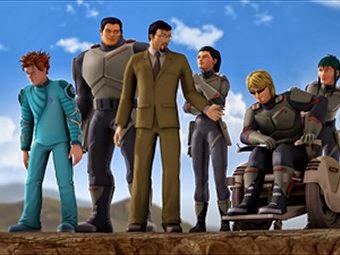
Once in a while Netflix completely surprises me and shows me something that I really like. In this case, it’s the animated superhero show The 99. The 99 is a 26-episode series written by Dr. Naif Al-Mutawa, that focuses on a group of heroes who are powered by magical gems called Noor stones. Supposedly, there are 99 stones. Each stone grants it’s user different powers. The first one to be found is a paraplegic man with the power to send out pain waves/healing waves from his hands: John Weller.

   The others found all have different abilities and powers, and all have Arabic names given to them once they join the 99. I suspect it has to do with the 99 names of Allah…well, and 99 Noor stones. Of course, I myself am an Agnostic, but I love discussing multiculturalism! As for the superheroes: There is (mainly) Jabbar The Powerful, (Superstrength and invulnerability) Darr The Afflicter (John), Mumita The Destroyer (Superstrength and agility.) Noora, The Light, (Light-based  powers and  empathy.) Jami The Assembler (Super engineer.) Those are the main three from what I see. Although the series plays off of Islam, the show itself is more about universal values of good and evil, and happens all around the world (Hong Kong, St. Louis, Hungary, and Jakarta, to name a few…) just  like the X-men and the mutants.
     
Dr. Ramzi Razem serves as the mentor (The Professor X, if you will.) of The 99. One thing I liked about the show was how well it depicts in my mind, how people would react to being superheroes. John doesn’t just get on a plane and fly off with them! No! He tells them to get out of his house and go away until his powers go out of control and they chase him down! Although John is a little bitter in the beginning, and generally has a negative view of his chair (Except when The 99 upgrade it into a sort of armored Permobil powerchair!) I tend to think that’s due to his tough-as-nails persona and background, rather than pity.

    In fact, I have to say, for all it’s cheesiness, I really liked The 99’s depiction of John’s disability. He sort of moves extra-consciously…with a click before he moves from his powerchair of course. And although I never realized it…that’s how I move too. I sort of have to think “Okay, turn here; then straight ahead.” but of course it’s all habit. Early episodes have some nice examples of John’s POV, all punctuated with clicks from his chair. Little things like this I notice. I’m always somewhat pleased when I see disability in mainstream superhero media!

     Of course, opposite Ramzi and The 99 is Raghul. Raghul is the Magneto to The 99’s X-men. A nice plot twist occurs when John becomes suspicious of why Ramzi brought them to The 99 Mansion, and gave them codenames. Why do superheroes need secret identities, anyway? (I know, to protect their loved ones.) It turns out that they had been working for Raghul, and the man they were told was Raghul was Ramzi! Nice twist on the secret identity theme. Anyway, Ramzi reasons that since they already have codenames and a secret base, he might as well use them for Good.

     The base of The 99 is in Selville, Spain, on the ruins of a 13th century Islamic library. I like how the show is based in Arabic/Islamic mythology and culture, and explores themes of ethics, social justice, and multiculturalism, in much the same way as X-men does…but just as X-men is not specific to any religion…The 99 has a different cultural/historical setting which adds to the backgrounds of the characters and Good vs. Evil narrative of the show.

Though Islamic culture is important to the show, the religion is never explicitly  discussed. Though I felt like maybe it’s time we have strong Islamic superheroes? I felt like it was a missed opportunity. It’s time we had a serious intercultural dialogue in that respect. If Nightcrawler can discuss Christianity, why not John Weller discuss Islam? Though I really like that the show went for (to me.) something new, to show how people act on cultural values; and for including a bit of disability culture as well.

The only thing I didn’t like about this series was…the animation. Until Beware The Batman proved me wrong, I’ve always kinda thought 3D animation was inherently clunky and awkward…and it’s still pretty bad here. Often, it feels more like a product of the late 90s than modern animation…but the action and themes covered are good, even though animation is lacking! If you’re looking for more disabled superheroes, or just a new show to watch about superheroes, I highly recommend The 99 for its cultural settings, sneaky plot twists, and cool superheroes! I’d rate this 3.5/5 stars, but just for animation issues! Give it a watch! I was pleasantly surprised!