Showing posts with label cultural analysis. Show all posts

Monday, February 10, 2025

An Analysis of “Mein Krieg My Private War”: Amateur Films by German WW2 Soldiers (1989/1990):

An Analysis of “Mein Krieg My Private War”: Amateur Films by German WW2 Soldiers (1989/1990):

Bringing Memories To Life:

“I think I still have my 8mm Siemens here in this wardrobe.”* The former German soldier, a narrow-faced old man now with unkempt tufts of white hair moves a heavy vacuum cleaner out of the way, and he sorts through the old closet, and pulls out a hefty old machine that looks like a miniature metallic jack-in-the-box. “Ah! So, it was the 16mm model, then! Look here!” He says, out of breath. The old man takes the big square camera and turns the crank on the side so that the lens is slowly exposed. “Hey, it still works!” he says excitedly. “I’ll be, look at that. Pretty hefty, ‘ey?”

As the man walks to a white room where a small table is sprawled with old black and white photos, the German seats himself in a big red armchair, his British translators sitting opposite him behind the lens of a camcorder so as to be transparent. “I am always amazed how these photos excite my senses...” He says, his voice falling from exasperation. “I still remember the smells of burning wood. The pictures...they sure bring memories to life, don’t they?”

He began slowly with a deep breath: “At first...we didn’t quite know where we were headed. Then, I saw this sign in some sort of Polish script or something as we headed further eastward from Berlin, and then I knew we were going to invade Russia. In the train, the next day our commandant said to us: "Boys, I'm not supposed to tell you, but 4:00 is attack time. We all had butterflies in our stomachs; we didn't know what to do." The face of the man then turns and laughs at an old film shown on a projector: German soldiers drinking beer around a campfire. One sticks his hand on the lens so as to hide.

"Aha! There I am! With a mustache, even! Look! And I was camera shy.

"Camera shy?" asks a translator.

"Camera shy!" he laughs.

ANIMALS TO MEN:

The next former soldier is a bald, tall man with glasses and an orange sweater. He sits in a dimly-lit room, possibly a darkroom, with a small round off-white table. The bookcases and shelves in the background suggest he has knowledge of his dark past. He begins nervously, speaking with a cracked voice. "My parents were of the opinion that anything that was considered good must be good for their son, too. And in these times... (falling voice, notably sweating...from clothes?) ...it was considered..."good" to be in the Hitler Youth; you see, not to be an outsider." Cut to black and white footage of a line of boys in Hitler Youth regalia; brown shirts, khaki shorts, and swastika armbands. They are carrying a big swastika flag on a pole and marching around a hilly meadow. "I think I was...14 years old, then? Yes, 14 years old."

He explains that his parents were very curious about what a young boy does in a Hitler Youth camp, and so they gave him a camera. But, he only took pictures of what interested him at the time. You then cut to photos of puss willows and a boy in a Hitler Youth uniform cleaning the front wheel of a bike.

"There was a certain regimentation to it all, you had a sense of purpose." He says. "You didn't walk around aimlessly. You marched." Footage shows boys raising the flag in a busy town center next to two Nazi troops. "I remember one day I was being very curious and troops came by me, and I looked at them, thinking "Aha! What's this, then? And a pedestrian grabbed me by the arm and barked: "STRETCH YOUR ARM OUT when the Führer's troops pass by! Then, I learned to stretch out my arm and stand at attention when they passed by from then on."

The old man then comments on some color footage of a teenage soldier smiling, standing at attention and marching, which he happily explains to be himself in basic training. Then, his voice becomes quiet as more footage of basic training is shown. Two men crawling on their stomachs in the snow. A man hopping up and down like a bunny. Men with bayonets stabbing a dummy. "Of course, when you were in basic training you had to be tough or the men would tease you and call you a softie. On the other hand, I did not want to lose my friends. So, I wanted to stay in the middle ground, you see." He says, while the footage runs.

"Did you, also?" Asks the male translator.

"Well..." The old intellectual hesitates slightly, pushing up his glasses. "Remember: I was 18; I was a different person!" He speaks fast and holds up a finger. Then, again at normal pace. "Now, I am 66. Back then, I had no way of knowing that their objective was to humiliate us, to break our will, to make us behave like animals, so that you were capable of carrying out ANY order without asking 'Is this right or is this wrong?' And that makes me an accomplice. Yes. As a soldier I was an accomplice." "

Did you participate in the firing squad units [Todeskopfeinheiten] or did you see any in Russia?" Asks the female translator. He jerks at his collar and takes a deep breath, relaxing as he rests his knuckles back on the table: "No. I never even saw a firing squad but I heard stories when I was a POW in Kiev. Of the atrocities that the members German army, me, my friends, and Germany had committed." His voice is strained (from tears?) and he continues, gesturing slowly and half-heartedly to swat away the memory. "At first we...we thought this was exaggerated, or Soviet propaganda; they did call us the "fascist hordes", and to us the Russians and the Jews were subhuman. [Untermenschen]." Cut to a scene of gallows with 5 Russians hanging, all marked with a gold JUDE [Jew] star on their chest. A sign reads: THESE JEWS AGGITATED THE GERMAN WEHRMACHT. [Hitler’s army] “But when I was in Kiev, I saw the Russians starving, wrapped in blankets...they didn’t seem like a threat; they were human. I saw photographs of the concentration camps, too.” Next, the German is huddled over filing cabinets marked with the names of cities and concentration camps. “These are my archives. I decided to publish them.” The German nods.

MEN TO ANIMALS:

“NIEMAND erwartete den Russlandfeldzug!” [NO ONE anticipated the Russian campaign] yells a round, tanned interviewee wearing a loose red tie and open grey business suit, throwing up his hands emphatically. He sits in a yellow armchair, his stance is slouched, comfortable and relaxed, but he speaks passionately of the journey to Russia: “The feeling was...the...the...well, the same feeling when you undertake a journey!” Now, they were soldiers he says. Now, they were doing something. What mattered to him was the journey though, and not the politics: “I was an instrument of the state! The word kill never occurred to us, that was not a topic.”

he says, waving his hands. “I had orders and I had to fulfill them!” He tells of being in Sevastopol, and sings a song in Russian he heard when he was with 90,000 (Russian) POWs. He shot films of his artillery unit shooting down a Russian fighter plane with their carbine rifles. He laughs: “You see, it was a hornet that stung us. And that was very unusual at that time, to shoot down a plane with rifles. But, it was the only thing we had. He could’ve killed maybe five of our men.” The shot centers on the dead pilot, with a blue sweater among the smoking wreckage. “There’s the pilot...gray-blue sweater. A bit still there.”

“One felt like one was a rabbit! Poking in and out of the trenches, and eating and celebrating! War heightens the senses, you know.” Footage of men in trenches, digging, then drinking beer, and eating hard bread. He continues, this time around a small miniature model of the Brandenburg Gate, positioning Napoleonic cavalry models to the right, left, and center. “You see, I didn’t want to destroy; that’s not me. I only wanted to observe. I didn’t want to see ruins.” He says.

Cut to him back in the armchair, behind a large bookcase. It is obvious the translator has asked a question about the trains. “Oh, the trains during the wartime are a great topic!” He smiles. “We were so covered in armor, and our backpacks and supplies that we could barely move. The further east we came, the more room there was on the train. But, there were a few who packed instruments and...and we danced, sang, and until…uh, Russia.”

Then, in the first battle, at Sevastopol, he saw the first dead person ever in his life. “There was a German soldier: wedding ring glistening in the sun, face red… and bloated…flies around his mouth…” Footage of wounded Russians standing in line, bandaged. “There is no war manual that says ‘What do I do with 90,000 prisoners!” He says, “I looked after some Russians and give them water, dressed their wounds. I am amazed at how determined these wolves were. Look! There’s a Russian pilot. 17 years young!” Close-up of a captured Russian pilot.

“You have a clear conscience of all of this? What about the pilot you shot?” “The pilot...yes… well, sure! Crystal-clear!” He smiles and clears his throat. “I could not tell you about all this so powerfully today if I DID…NOT…HAVE…A CRYSTAL…CLEAR…CONSCIENCE!” It is unclear to me whether this was meant to stop the questions, or if it was said slowly to reinforce his own affirmation.

SPARE ME THE ANSWER:

An older-looking German, his hair sparse, wearing a white business suit and tie with glasses. He is still notably blond as steers the wheel of a car. We arrive at a mall of some kind where he stands in front of a booth with a map on it. He begins his story: “I didn’t want to be in the army, I wanted to be a photographer. But, my parents said this job is not practical. You need discipline, and the army will prepare you for a job.” He was deployed to Vitebsk, Russia. His parents, as a farewell gift, gave him a camera. “It was amazing to me that we did it, but we attacked Vitebsk from the west. The Russians anticipated this. For hours, nothing happened. I climbed up a fir tree to watch, but nothing. I wanted action.” He goes on to explain that the battle began when they found out the population was living underground in earthen bunkers.

“And what did you do with the Russians you found?” Asks the male translator. “Oh…They were…” He exhales, removes his glasses, and touches his palm to his forehead. “Questioned. Rounded up. Shot.” “Did you hear the firing squads or see them, too?” The translators asks. “I saw them, too.” He says. “Did you participate in them, too?”

He turns stone-faced, whispering inaudibly...weeping softly. “Do I have to answer that? Spare me the answer, please.” His head in his hands. “I was glad to be doing what I wanted to do.” He is now standing, having collected himself and is apparently showing the translator a photoalbum either of dead Russians, or his comrades. He is frustrated and flips through the book fast and angrily. “See here? Gone-gone-gone-gone-gone-gone! Well, I’ll be…! A complete causality list! Colors you’ve never seen before. Only in Siberia at -55 C.”

The next shot is of the man at a department store in the aforementioned mall. He holds a large music box [Glockenspiel, toy clock] and says: “If you turn the crank this way, the soldiers march around the face of the clock. This toy is beloved of people of all ages. The parents buy them for the children, see?” He chuckles, pointing at the nutcracker- like soldiers, and showing of the cloudy panorama on which is painted a little girl in a pink dress. “But, the parents enjoy playing with it more than the children. And here’s how you turn it off.” He flips a pendulum switch at the top. The soldiers halt.

SEEING IS SEEING:

A full-lipped, round man in a neatly-cleaned business suit walks down a long hall, opens the white door, and enters a room with a large, crank-operated projector. He turns the crank, then faces the camera and speaks. “I saw many people taking photograph but very few were filming, probably because there were little film materials to be had. But, I made sure I had many sources. At the start, everything was available, there was Kodachrome film even, and my Kodachrome film...the last I had developed in ’42, and they kept their color very well...turned out great.” He then describes at length how the camera works and that it stayed in perfect condition, even in Moscow in the extreme cold. It is sounding as if he is personifying his camera, and attesting to his own physical endurance.

Color images of a swastika flag waving over a barracks transition to young men, firing rifles. Cut to the interviewee in a large leather armchair. Behind him is a bookcase. He now wears glasses. “That is a normal part of learning how to fit in to society.” He says of his basic training. “Naturally, when somebody fell out of line, there were consequences.” The next film shows a bombed-out high-rise building in Poland, the top completely blown off. “...we climbed to the top, got in, and filmed it. It was just interesting at the time. You can’t say: “You must evaluate this morally; as the majority of people say today.”

He explains his departure to Moscow, and not knowing originally where he was going. “Am I going to Persia? Turkey?” He muses, and then reveals that: “Everyone was hopeful that the destination was Moscow.” Color footage of an armored car, bearing a swastika flag, atop which a young man stands. Then, the camera focuses from the window of a jeep, and pans along the wreckage of another car: “The Russians would hide along the roads and try to flip the cars, crack them, or kill the driver,” He smiles, and explains matter-of-factly. “So that that didn’t happen, you spotted a hole, you threw a grenade in, and that took care of it.” “Were you scared of that?” asks the female translator. “No. It could’ve been anybody bombed out there. The jeep here took a direct hit. Well, that’s war.” Black and white footage goes on, showing a pile of dead bodies, and men being thrown into ditches. “Here I was in Moscow, all alone.” He says. “Why did you film the dead bodies?” asks the translator. He becomes a little defensive, and waves his hand as if to dismiss her. “That’s war.”

Toward the end of the interview he says that he has no regrets, only that he never saw the Western front, in wartime too, because “seeing is seeing” and the circumstances don’t matter.

Conclusion:

Mein Krieg: My Private War is about war. Consequently, it also follows the soldiers as they experience different stages of the war. Comradeship, joy, death, and horror. The reactions ranged from abstraction of humans as animals, or returning to a natural state so as to avoid human conscience, to the deconstruction of the animal propaganda to confront human conscience. Soldiers were represented as instruments, toys, or as just observing events over which they had no control.

The question must be asked: why then was it filmed? Obviously, all the men experienced death, but most stopped short of expressing any guilt directly, except for the man in Kiev, who joined the Hitler Youth at 14. Responses to death ranged from avoidance of acknowledgment. “I was amazed at how determined these wolves were.”, “Spare me the answer.”, and “That’s war.”

Rather than seeing the horrors of war as they were, they were regarded as interesting, but something you did not judge morally. Accordingly, the more soldiers identified with their enemies as humans, and their actions as humans rather than instruments or animals, feelings of grief and remorse increased. The abstraction of enemies is directly related to, in other words, being a good killer vs. being a good human. As we worry about the dying WWII population, we must not forget the stories of the Germans.

The Allied powers have reveled in the “glory” of its victory over Nazism far too long without considering the consequences of war itself. We think we are invulnerable, because we think we do not need two sides of the story. __________________________________________________________________

* My translation differs from the film version of Mein Krieg: My Private War, in order to preserve both the phenomenological happenings (such as stuttering) and the narrative-analytic continuity. Rather than cutting from story to story, I proceed soldier to soldier with no cut scenes. As such, the information is not presented in the order of the film. It is hoped that I could better represent their stories holistically and thematically in this way.

Bibliography:

Eder, Harriet. Kufer, Thomas. Mein Krieg. BBC Elstree, 1990.

FULL MOVIE - YOUTUBE:

Thursday, February 29, 2024

Kenji's Ending: Katawa Shoujo

Kenji's Ending: Katawa Shoujo

There's one ending in Katawa Shoujo where you die. I just want to talk about it. Since this is a visual novel, you have to show interest in one character, and then that character's narrative opens up. But, since Katawa Shoujo also deals with disabled characters, or characters that are negotiating disability, I find that many people often unknowingly get this ending.

So, what happens? Well, Hisao tells off all the girls after having a heart attack, and they express concern. Instead of picking one activity for the school festival, Hisao gets drunk with Kenji on the roof. Kenji rants about feminist brainwashing, how there will be a war between men and women, and you cannot trust anyone. So, he perceives everything as a threat to his masculinity as a blind man.

This is the only possible “ending” with Kenji, who otherwise is a clownish character, down to his theme music. But, it probably reveals the the most about his character. He simply doesn't know how to treat people as normal, because of his own sense of self-worth, or lack of it. Similarly, I think many players who first play Katawa Shoujo, unknowingly get Kenji's ending, where Hisao gets drunk and falls off the roof.

Again, this isn't because people are trying to be mean, or get the worst ending. This is simply storytelling. The game must continue with one girl's narrative taking over at the end of Act 1, the festival. If your answers are all over the place, the game can't continue. I think many players got this ending not through meanness, but through expressing curiosity about each girl.

When I first played, I was naturally drawn to Emi, because of her having no legs, which most mirrored my experience as a quadriplegic. I think most able-bodied players may not have that experience where they see their interests and positions mirrored in Katawa. They simply try to investigate the strange world of disability, and only later discover that they are more than they appear to be.

There's a lot of reasons why one might accidentally fall into Kenji's ending, if as previously stated, players are unfamiliar with the game's structure, just expressing interest in characters, or simply wanting to know more about disabilities. I'll put the ending down here, just to illustrate it. Kenji's ending might be the “worst”, but it is the most revealing of his character, and perhaps of the players' possible mindsets.

Wednesday, January 31, 2024

What Is A Visual Novel?

What Is A Visual Novel?:

“As a genre, "visual novel" is not defined by a mechanic or an aesthetic, but rather a distinctive presentation: VNs focus on presenting a text-based story using click-through text boxes, accompanied with static character graphics, and usually feature little to no actual gameplay.”– TVTropes.com

What is a visual novel? I guess the best way to describe a visual novel is like a virtual book that you read and occasionally make choices in that effect the story. But, then things get a little more specific. For example, many fighting games have “story modes”, which have larger plots connected to each character through a series of fights. Also, many role-playing games have story elements.

The main difference is that a visual novel is told mostly through text like a book instead of graphics. There can be graphics, but the story isn't told through the graphics, necessarily. But, then it gets even more complicated when you mix genres like fighting game-visual novels. The story is mostly text, and player decisions effect the plot, with an added fighting game mechanic.

This difference between “story mode” in most fighting games vs. fighting game-visual novels is mostly about how player decisions effect the plot. For example, if you lose fights in a traditional fighting game, you can't progress. The fights are the main game. In fighting game visual novels, losing a fight would effect the outcome, but the story text would continue. The text is the main mechanic, not the fight.

Then, you have kinetic novels, where there is no game at all. No choices are made by the player. It's a book in videogame format. You read it. There are no multiple endings, and there are no side mechanics. I don't really play visual novels that don't have gameplay. I like to make choices.

I just wanted to make this post because I've been posting about visual novels. And I realize that not everyone knows what they are. My favorites are Katawa Shoujo and short comedies like Leave Mr. Bear Alone. But, even some games like Blazblue, a story-heavy fighting game, have visual novel modes that are pretty fun. Like books, they can be any genre, not just dating games. If you have time today, look for a visual novel on Steam. You'll find something you like!

Saturday, September 4, 2021

Stroszek (1977):


Stroszek (1977):

"In Berlin, an alcoholic man, recently released from prison, joins his elderly friend and a prostitute in a determined dream to leave Germany and seek a better life in Wisconsin."

Stroszek is part morality tale and part absurdist comedy. It's tragedy lies in that we want these misfit characters to succeed. But, after an agent confiscates his pet chicken, Stroszek and his band of misfits confront the darkness of the criminal underworld and American life. A Werner Herzog classic! If you can stomach the suffering and madness that is his trademark, give it a watch. It's actually darkly humorous. Free on Tubi.

Saturday, February 8, 2014

Street Fighter II: The Animated Movie (1994) Review:


Street Fighter II: The Animated Movie (1994) Review:

“The world is your arena, now. Not just the street.”

- M. Bison to Sagat

   In the Olympic Spirit, here’s an anime based on a 90s fighting game (which I remember playing from a van for the first time, and being completely enthralled by!) about international fighters! But, Street Fighter II: The Animated Movie is no mere videogame movie. It also combines buddy cop, kung fu, and Terminator motifs all nicely meshed together against the backstories of the characters. The best fighting game movie ever!
 
   Now, yes, I know if you don’t know about the game, it’s not going to grab you. But, I think it’s the best videogame movie ever made because, for starters, there’s actual fighting in a fighting game movie. Within 15 minutes there are about 4 matches. (Ryu vs. Sagat, Ryu vs. Fei Long, E. Honda vs. Dhalsim, Ken vs. T. Hawk!) and many of the special moves of the characters are used throughout the fights.
 
  Street Fighter II’s impact on the world of videogames is colossal enough. But, this movie captures enough 90s cultural tropes to make it more than just a straight kung fu flick. And that’s what makes it great! To begin, M. Bison (Or Vega in Japan…how’d this movie work out over there?) is tracking down Ryu (And yes, it’s REE-you, not RYE-you.) via “monitor cyborg” after he beats Sagat. Ryu’s power level is 3620, which is supposed to be very high.

  Bison’s psychic power along with his cyborgs allows him to turn people into mindless terrorists (Cammy assassinates an English anti-drug politician under such hypnosis!) and drug dealers for his evil organization Shadowlaw.  So, Ryu is on the move at random around Asia: China (Fei Long’s encounter.) India, (Where he meets E. Honda, who beats Dhalsim.) and then Thailand. He is portrayed as a nice guy who’s just passing through and looking for the next good fight, but he knows that his only equal is Ken Masters of Seattle, who trained with him for 10 years in Japan.

Ryu’s movements catch the attention of Shadowlaw, INTERPOL (Represented by Chun Li, misspelled as INTERPOLE, but, oh well.) and the US Air Force, both of whom are investigating Shadowlaw. At first, Guile (The All-American Air Force Captain, who keeps an outrageously cool hairdo.) doesn’t want to investigate with Chun Li, but after she’s attacked by Vega (Balrog in Japan…again, how was that movie different, guys?) The Spanish wall-jumping ninja, he agrees to track down M. Bison for her.

    Although, it felt weird in the 90s to me, now I think the US military probably WOULD investigate a terrorist organization turning people into zombies. So, now it feels prescient with The War on Terror.     Meanwhile, Ken Masters is being followed in America by Chun Li, Guile, and Bison’s cyborgs, as Bison has figured out that he’s Ryu’s equal. He’s more of Smart Alec than Ryu. His scenes are accompanied by Alice in Chains, which is nostalgic. Second to the final battle is a three-way fight in Thailand (Because of course, Thailand is the last level in the game.) between Guile/M.Bison, E. Honda vs. Balrog (In Japan, M. Bison.), and Ryu vs. a mind-controlled Ken.
   
    Finally, M. Bison is defeated by a double Hadoken by Ryu & Ken into his jet engine. I’m told Street Fighter: The Animated Series picks up after the credits scene where M. Bison follows Ryu in a semi! The credits music is Rage Against The Machine. How’s that for 90s nostalgia? This movie is awesome, and far better than anything Hollywood attempted with the franchise. And drawn in excellent manga-style!

     Again, if you don’t know the game, then the entire post probably just sounds like a 90s nostalgia rant. And that’s okay. Because partially, it is. But, in the game it’s an international tournament. Maybe it is here too, but filmed on cyborgs. Whatever the case, I thought it was a good tribute to the Olympics, and Blanka, the beastman of Brazil actually tangles with Zangief, of Russia, in the movie! Still I can’t think of better representatives for the US of A than Guile and Ken!
   
   This movie is great! 4/5 stars! Well, the dialogue could’ve been delivered a bit better. It’s amusing to hear Ken say things like: “Buffalo, or whatever your name is…you’re full of crap!” A wild ride that combines all things 90s with all things manga! If you don’t feel like playing Street Fighter II afterwards, something is wrong! Go Ken! Go Team USA!  


Thursday, February 6, 2014

Avengers vs. Justice League: War

Avengers vs. Justice League: War

Captain America: “We need a plan of attack!”

Iron Man: “I have a plan. Attack!”


So, in my last post, I made the claim that there are aesthetic differences in the movie Justice League: War to make it different from Avengers, but that it was basically the same plot. The main aesthetic difference I argued, was fear as a motivator. From the beginning, it is established that Batman is a fugitive, hunted by Green Lantern.

    The heroes in Avengers, however, start out as heroes, and active members of their respective communities from SHIELD to India, for The Hulk. In Justice League: War, The impetus for banding together was only the invasion; but they didn’t have 3 hours to jibe and develop relationships between the characters. Iron Man/Hulk do a good job joking and teaming up to work on the alien object, even though Cap chastises them for being unfocused.

   So, from the start the heroes are paired together, and play off of each other. I often say of the Avengers movie that it is a good example of a viable theory of group communication called “Forming, storming, and norming.” It is of course, arguable that Hawkeye needed a little more exposure, but as the only one in this group who hadn’t had a movie yet, he couldn’t be in the first two stages. Justice League: War has little time to develop and thus normalize the heroes roles: essentially we have “forming, storming, Batman!” But, what is forming, storming, and norming?

    Forming is when the group forms. Black Widow serves this purpose, as well as SHIELD, as well as pairing off the heroes to form relationships…as when Cap breaks up a fight with Tony Stark. Superman also fought with Batman like this. But, then, Batman has to rescue Batman. Also, it’s telling that Wonder Woman avoids meeting the President. I know that’s comic relief, but she acts as a fugitive as well. Whereas Cap keeps the group focused by remaining in his past role: The soldier.

  In this respect, each Avenger contains something that connects him to the mission….and that they’re opposed to. Storming is when they question the mission. Even Tony Stark’s suspicion of SHIELD plays on Cap’s trust in SHIELD. Hulk’s rampage and defeat by Thor connects him to Thor. So, he ends up paired with him. Justice League: War has a storming stage, but it is short, since the heroes never meet until the invasion, and Batman rescues Superman. Abducting Superman for conflict reasons, I feel is an odd choice, but it served to show Batman as a leader, and he takes charge, but the end result is the group never feels solidified…it’s Batman’s show…but that’s okay! They have forming, storming, Batman.

   In sum,  Avengers had more time to dealt with forming, storming, and norming. The norming is solidified by the teams mutual avenging of the death of Coulson. It feels less dark because there is more humor (Iron Man’s a jerk, sometimes, but he enjoys himself!) and has more time for the group’s conflicts to resolve. But, in Justice League: War, DC wants the tension to be there, to use a phrase, because he’s Batman.

  Batman thrives off of being a fugitive, and why not? Batman is popular, and this gets the team together quicker…at the cost of character development. In a sense, DC must go with the Batman feel at this point, because the audience already knows him. In a similar vein (Although you have to credit the writers!) Marvel’s Avengers follows the aesthetic of it’s most bankable character for much the same reason. And they are both billionaires…ironic since they are the most bankable.

Ultimately, the cultural aesthetic comes down to who was leading the group. Cap leads the Avengers, kicking into full army mode and formulating his plan of attack! Batman serves as a leader, but only after Superman is underplayed. But, the circumstances called for him to step in…Because he’s Batman! And it would save them making more movies.

Even though Justice League: War is a good preview of what a Justice League movie might look like, to me, it’s clearly following an Avengers formula…but that’s okay! It’s a good decision. That just means they’ll have to go with more familiar characters, and resolve less interpersonal conflict. But, Batman thrives on conflict, and just happens to be the most recognizable character in that universe. Yes, the Avengers all had movies, but DC is playing catch-up, and doesn’t have time to build up there characters. So, Batman may be the hero the DC movies deserve…but not the one they need! Only time will tell!

Bonus Question: Who do you think would win? Avengers or Justice League?


Thursday, October 17, 2013

Planet of Snail (2012)

PLANET OF SNAIL (2012)


 Young-Chan Cho: “All the deaf and blind people have the heart of an astronaut.”

Planet of Snail is a documentary from South Korea. It is very slow-paced and plays with minimal sound to simulate Young-Chan reliance on tactile communication and finger taps as opposed to always using voice. His voice, one might say is the lack of sound. The story follows him along with his wife Soon-Ho. Soon-Ho has a disability caused by degeneration of the spine.

Together the film explores their mutual dependency and quiet, slow lives. The reference to Young-Chan Cho as an astronaut in the Planet of Snail is interesting because I too consider myself an alien. Some things that an able-bodied person can do very easily, I can’t. But, I think from that I gained a desire to explain my worldview. For Young-Chan Cho, it’s the same. On one hand, he talks about his disability as no different than fading memory for a sighted person. When you remember something with sight, it’s never as clear as it was when you saw it the first time. A very insightful critique of sightedness!

    On the other hand, Young-Chan’s poetry reveals a deep understanding of how his life is alien. “What I see in front of me is my reality.” He says. “I am deaf-blind even in my dreams.” In spite of this determination, he encounters obstacles very early on in the film. While taking a Hebrew exam, Young-Chan’s professor says that he had the words in the right order, but his assistant transcribed it wrong. That is, his wife, not his assistant. But, he gets an A+!

    Later in the film, we see Young-Chan eating with friends, who look as though they may be deaf-blind as well. They get into an argument about why he married, and the other friend believes he may never marry. Much of this argument is done through tactile communication and finger tapping. I don’t know Korean sign language, and only understand little bits of American Sign Language, but the finger tapping to me seemed vital to understanding the language. Young-Chan’s friend believes he married Soon-Ho to be a live-in caretaker, which Young-Chan Cho denies, but seems shaken by.

   Through his friend, we see his clay crafts, including a mug shaped like a naked man. Young-Chan explains that he didn’t like that one very much. Soon-Ho says that sometimes he takes care of her, because sometimes her pain is so bad that she can’t even pick up the phone. “I couldn’t even say hello. I could only make screeching sounds.” She says. Nonetheless, we see Soon-Ho helping Young-Chan around the house more often than vice versa: Fixing a light, helping with food, walking on the beach, even helping to organize Cho’s play with his friends.

     The film ends with a solo trip to a doctor's appointment, where he admits he was scared to be without his companion. “I felt colder.” He says.  Then, Young-Chan Cho goes swimming, where he says he can open his eyes and see a different world. (As opposed to The Planet of Snail.) In closing, he says he's only waiting to see the most precious things. He and I have much in common. We are both astronauts; we both use words to paint our lived experiences with disability; we have many of the same fears. What will happen to me when my friends and caretakers are gone? The film explores these fears, which at times seem to contradict his coping mechanisms…art and poetry which transcends his body.

    The film is very slow-paced, but there was enough going on that intrigued me that I never lost interest. I love movies about disability experiences, other planets, and other cultures and ways of life. I identified with the main character; but only insofar as he uses art to overcome his disability, such as I try to do. The rest was new to me: The finger tapping, Young-Chan Cho’s beautiful descriptions of his disability in poetry, having a partner vs. having friends, and negotiating each other’s disability. These were all wonderfully new to me. The slow pace also helped me drink in Young-Chan's world.

     I found Planet of Snail to be a fun, dramatic and captivating experience… it is not  just internationally appealing to me, being a Korean film, but it is interculturally appealing too. I mean, I related my experiences with disability with Young-Chan They didn’t always match up. For example, in my dreams, I'm able-bodied, though it by no means is a reflection of de-valuing my life with a disability...I can simply do more in my dreams. Also, Young-Chan says sometimes he knows he’s being stared at. I would tend not to focus on it…nonetheless, I do know it probably is happening.

Anyway, this is a great film that explores many themes about disability and relationships, and the role of art as a tool for life. Highly recommended…I’d say 4/5 stars: the slow pace might be off-putting to some, but in my case, it helped me catch details like the finger tapping as communication. A wonderful film! Go see it!


Thursday, October 3, 2013

THE 99 (2011) REVIEW:

THE 99 (2011) REVIEW:


Narrator: “It is said that the light of one heart can illuminate all the darkness in the world.”

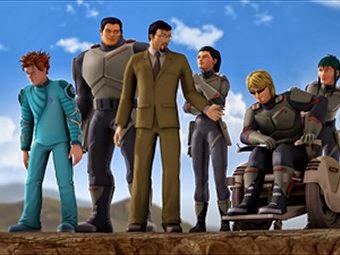
Once in a while Netflix completely surprises me and shows me something that I really like. In this case, it’s the animated superhero show The 99. The 99 is a 26-episode series written by Dr. Naif Al-Mutawa, that focuses on a group of heroes who are powered by magical gems called Noor stones. Supposedly, there are 99 stones. Each stone grants it’s user different powers. The first one to be found is a paraplegic man with the power to send out pain waves/healing waves from his hands: John Weller.

   The others found all have different abilities and powers, and all have Arabic names given to them once they join the 99. I suspect it has to do with the 99 names of Allah…well, and 99 Noor stones. Of course, I myself am an Agnostic, but I love discussing multiculturalism! As for the superheroes: There is (mainly) Jabbar The Powerful, (Superstrength and invulnerability) Darr The Afflicter (John), Mumita The Destroyer (Superstrength and agility.) Noora, The Light, (Light-based  powers and  empathy.) Jami The Assembler (Super engineer.) Those are the main three from what I see. Although the series plays off of Islam, the show itself is more about universal values of good and evil, and happens all around the world (Hong Kong, St. Louis, Hungary, and Jakarta, to name a few…) just  like the X-men and the mutants.
     
Dr. Ramzi Razem serves as the mentor (The Professor X, if you will.) of The 99. One thing I liked about the show was how well it depicts in my mind, how people would react to being superheroes. John doesn’t just get on a plane and fly off with them! No! He tells them to get out of his house and go away until his powers go out of control and they chase him down! Although John is a little bitter in the beginning, and generally has a negative view of his chair (Except when The 99 upgrade it into a sort of armored Permobil powerchair!) I tend to think that’s due to his tough-as-nails persona and background, rather than pity.

    In fact, I have to say, for all it’s cheesiness, I really liked The 99’s depiction of John’s disability. He sort of moves extra-consciously…with a click before he moves from his powerchair of course. And although I never realized it…that’s how I move too. I sort of have to think “Okay, turn here; then straight ahead.” but of course it’s all habit. Early episodes have some nice examples of John’s POV, all punctuated with clicks from his chair. Little things like this I notice. I’m always somewhat pleased when I see disability in mainstream superhero media!

     Of course, opposite Ramzi and The 99 is Raghul. Raghul is the Magneto to The 99’s X-men. A nice plot twist occurs when John becomes suspicious of why Ramzi brought them to The 99 Mansion, and gave them codenames. Why do superheroes need secret identities, anyway? (I know, to protect their loved ones.) It turns out that they had been working for Raghul, and the man they were told was Raghul was Ramzi! Nice twist on the secret identity theme. Anyway, Ramzi reasons that since they already have codenames and a secret base, he might as well use them for Good.

     The base of The 99 is in Selville, Spain, on the ruins of a 13th century Islamic library. I like how the show is based in Arabic/Islamic mythology and culture, and explores themes of ethics, social justice, and multiculturalism, in much the same way as X-men does…but just as X-men is not specific to any religion…The 99 has a different cultural/historical setting which adds to the backgrounds of the characters and Good vs. Evil narrative of the show.

Though Islamic culture is important to the show, the religion is never explicitly  discussed. Though I felt like maybe it’s time we have strong Islamic superheroes? I felt like it was a missed opportunity. It’s time we had a serious intercultural dialogue in that respect. If Nightcrawler can discuss Christianity, why not John Weller discuss Islam? Though I really like that the show went for (to me.) something new, to show how people act on cultural values; and for including a bit of disability culture as well.

The only thing I didn’t like about this series was…the animation. Until Beware The Batman proved me wrong, I’ve always kinda thought 3D animation was inherently clunky and awkward…and it’s still pretty bad here. Often, it feels more like a product of the late 90s than modern animation…but the action and themes covered are good, even though animation is lacking! If you’re looking for more disabled superheroes, or just a new show to watch about superheroes, I highly recommend The 99 for its cultural settings, sneaky plot twists, and cool superheroes! I’d rate this 3.5/5 stars, but just for animation issues! Give it a watch! I was pleasantly surprised!


Friday, September 27, 2013

Trigun (1998) Review:

TRIGUN (1998) REVIEW:


Vash the Stampede: “I'm like a hunter of peace. One who chases the elusive mayfly of love... or something like that.”

Episode 5, “Hard Puncher”

Yesterday, I watched Trigun. Trigun is a 26-episode anime done in the style of a sci-fi Western. It follows Vash the Stampede on a quest to clear his name and recover his identity. Though he’s quite the buffoon, he has a bounty on his head worth 60 billion double dollars for destroying the town of The 3rd of July. Yet, he refuses to kill anyone and dances to pop music and eats doughnuts and generally acts like a kid. The female insurance agents Milly and Meryl can’t believe this childish womanizer is the notorious criminal they call “The Humanoid Typhoon”!  

    But others aren’t so sure and challenge him in almost every town he goes. From gangsters and poor townsfolk to mad scientists in their weird mobile Krang-like bodies, (“Hard Puncher”) this leads Vash The Stampede on a mission to discover who he is, and spread love and peace while wielding two big guns, and a vicious reputation in spite of his childish nature.

   Along the way, he discovers that not only gangs, but demons in league with gangs(!) are after him and he takes a preacher with him (Who also has a tortured past!) by the name of Nicholas D. Wolfwood. Honestly, everyone of the characters is very well fleshed out. Though Vash starts out naïve and childish even…even despite his comedic moments…he grows as he must defend himself, and face The Gung-Ho Guns…a band of demons! There’s one that goes invisible, a kid, a musician who plays in the key of “pain”, and even one that sort of looks like a steampunk Hannibal Lecter with a muzzle…and many more.

Honestly, I don’t want to spoil the show, but when Vash discovers who he is, the tone of the show becomes dark and morphs into a miasma of big gunfights laced with what it means to be a brother and forgiveness. Plus, it has aliens and demons in a western sci-fi setting. That’s a heck of a mix, but fortunately the mature tone is set by about episode 12, with a demon looking for Vash (“Diablo”) so it’s not too sudden.

   Between angry villagers, and preachers with gigantic cross-shaped machine guns, and of course, 60 billion double dollars, everyone except his few “allies” are out to get Vash. But, even they begin to grow and form their own agendas. Mille is another naïve one who just can’t deal with killing, but Vash learns he has to! And that a sinister force is behind his framing! The show deals with morality in the same way most animes do…by shooting mounds of bullets at it! But, Vash is determined not to kill.

    Overall, Trigun is one of the most layered identity crises I’ve ever seen in animation. The characters almost do a complete 180 once their agendas are revealed. For example, Vash begins to think it’s strange that Wolfwood carries a machine gun. (“Hey, whatever happened to "Thou shalt not kill"? Episode 10: Quick Draw.) while Wolfwood begins to doubt that his childishness is sincere. Bottom line: Things get ugly! And Milly and Meryl struggle to minimize his damage…as insurance agents…just like Vash struggles with killing. But, the revelation of who he is changes everything…or does it?

    Seriously, the twist is so great my head is still spinning thinking about it! You go into this thinking you know the character and the setting, and then…boom! Sneakier than Hideo Kojima squeezing supernatural conspiracies in Metal Gear, it all turns goes topsy-turvy! Are you ready for this? Well, you’d better be. I’m not telling! Anyway, Trigun has superb animation, great storyline and well-fleshed out characters! And if that’s not enough, it’s got guns, aliens, and demons! Go see it! 4 out 5 stars from me! Okay, here’s a hint!


Thursday, September 19, 2013

The Sorcerer And The White Snake (2013) Review:


White Snake: “Before I saw you I meditated for a thousand years, but those thousand years are worth less than a moment with you.”

The Sorcerer And The White Snake (2013) Review:

    Since I started this blog, it’s taken on a much more international flavor. I like it. So, today’s review comes from a movie done in Hong Kong in Mandarin. A demon falls in love with a human and wants to meet him and make his life better. Jet Li plays a martial arts-type Buddha Monk who tells her that such love is forbidden because they are from different realms. And Jet Li means business. In the opening scene he fights and traps an ice harpy for seducing people.

    But, these demons aren’t all like demons we find so often in Western culture who are inherently evil and seduce people. White Snake is more like Cinderella. She just can’t let her love see her as she truly is, which is a giant white snake. Her love is the herbalist Xu Xian, and she makes his medicine far more powerful. It arouses the suspicion of Master Fahai. (Jet Li!) He knows she’s a demon, but since she is benevolent, he gives her a warning. But, like all fairy tales, the warning is only the beginning. Even though she really loves Xu Xian, the monk shows up and forces her to reveal herself by magic, and of course, fighting. It’s like Cinderella meets Crouching Tiger, Hidden Dragon…and is as visually impressive!

     Like most fairy tales, it features cute animals that talk. (I like the turtle. He…talks…slowly…) One such animal is a mouse who tells Xu Xian of an herb so that she can come back to him. But, he is captured by monks, and his memory erased…this makes White Snake angry and she and her demon buddies (Including another snake-woman!) attack the temple to free him. This leads the monk to question if what he’s done is right as the temple is destroyed by an epic kung fu battle with White Snake summoning a tidal wave to smash the temple! The monks erasing Xu Xian’s mind are beset by little rats. Great scene. 

    So, anyway, despite being a fairy tale romance, it’s an action movie too! It was pretty good. Although it never really does lose the fairy tale tone…which I guess is all right, because it is a fairy tale…however it does seem wildly out of place when an epic battle suddenly erupts and there’s…talking mice around, and well…Xu Xian’s wife is a thousand year old Snake Demon fighting off monks for his affection! But, that’s the power of love, I guess!  

   Mainly, I like the film’s fantasy portrayal of the demon world. They’re just like nature spirits, I suppose. And I always enjoy learning the fairy tales of other cultures…so I might be a little more biased on my rating in this one. I could’ve used a little more Jet Li. Apparently, the other actors didn’t have as much training as him, so it leads to a lot of jumping around and using big special effects to end the fights. Which is fine, and flashy! But, I wanted to see a bit more martial arts. I wonder if the original fairy tale had martial arts in it?

     Anyway, it’s a good love story/action movie which shows the lengths people will go to for love. And what they’ll do to stop it when they’re convinced the love is wrong! But, ultimately, the monk decides that he’s caused too much suffering, and lets White Snake see Xu Xian one last time! For a rating, I’ll give it something in the range of B+. Certainly it’s artfully done. Even though it is a little weird to see talking mice and Cinderella with kung fu monks. But, different is good! It was nice to look at, even in the slow-moving romantic parts.

 Basically, if you need a cross between kung fu and the fantasy/action magic of Lord of the Rings, with Jet Li as a Gandalf figure, here’s your ticket! Also, if you specifically want that, you must have very unique interests! But seriously, see this movie. It’s got a little bit of everything with a kung fu movie flavor. Note: I know the movie is from 2011, but the USA DVD was released in 2013!


Wednesday, August 28, 2013

AE: Apocalypse Earth (2013)

AE: Apocalypse Earth (2013)


Capt. Sam Crowe: “We protect each other, or we’re all gonna die alone.”

    But wait…so you’ll still die, but not alone? And what does that have to do with “We protect each other?” The sad thing is, if AE weren’t a B-movie low-budget mashup of sci-fi blockbusters like Avatar, Predator, and Star Trek, then it might actually have been good! Okay…not really. The effects and dialogue are horribly cheesy, but in a Syfy movie kind of way. It is after all, a direct-to-DVD thing I found on Netflix.

    Since I’ve been talking about Batman so much on here I wanted to review real sci-fi. Even if it’s Syfy material. AE borrows all the clichés. Earth is destroyed and the refugees have to learn how to survive and get along with the natives while killing their cloaked pursuers, “The Chameleons”. So, it is quite literally Avatar, Predator and Star Trek. To its credit, I felt like it was at least trying to form its own narrative, using familiar settings, which is more than I can say for J.J. Abrahms.

There’s even a Neytiri rip-off (Except she’s green! Haha!) named Lea, who teaches the crew how to survive, and a Data rip-off  named TIM (complete with the “synthetic skin” makeup) who struggles to understand human nature. Except he’s a horrible android actor who stutters occasionally, and can’t maintain flat affect. In addition, he keeps saying he’d be happy to do things, which gets annoying.
 
Oh dear, what else is there to say about this cheesefest? The group slowly encounters natives, and it turns out some humans were being kept by the Chameleons in zoos/laboratories. In one of the cheesiest “syfy” twists I have ever seen, when they reach the natives, it turns out Lea never learned to speak or write her native tongue. TIM mentions that many languages have similar structures, and perhaps he can synthesize a translation matrix. He becomes the interpreter, and the societies unite against the Chameleons!

   The events are standard procedure: First the humans learn to survive, then struggle against death, and then build some communication. Captain Sam Crowe is no doubt an amalgam of Jayne from Firefly and Captain Kirk…he spews hopeful one-liners like Kirk (“We’re not going down without a fight!”) and has the same build and anti-hero persona of Jayne. Plus, the end scene with the attack on The Chameleons with bows and arrows is equal parts Avatar and The Original Series episode Friday’s Child! If you recall, Kirk defeats the Klingon occupiers with a bow and arrow, and help from the natives.

   As bad as the effects and dialogue are, I gotta admit it’s still good to see good old syfy cheese with gunfights, and cheesy morals…even if it is recycled. Hollywood puts so much effort into spectacle these days, I think they forget sci-fi is a window into human social structure, and nature. Although this just mashed three movies together, it was good to see those themes come up again, but the movie never makes you connect with the characters. It never really could anyway, given that this is a cheesefest. And the CGI makes Lake Placid look good.

Overall, I love-hated the movie (if that makes sense!) It had bad acting, stock characters, horrible dialogue, and bad CGI! And yet…I feel there’s something comically noble in the way that it mixes sci-fi action-survival clichés with the questions of human society and nature And who doesn’t like a good syfy gunfight? It’s basically Captain Kirk and Data vs. The Predator!
 
 Admittedly, this movie is getting a bad rating from me. Probably something on the level of E. But, I’d also put it in the so-bad-it’s-good category. The Star Trek fan in me loves the philosophical bits, however badly executed, the syfy fan in me loves the gunfights, and arrows, and action bits. It’s really the bad acting and CGI in-between that hurts. But, at least you can laugh at it! Cliché yes, schlock yes, schmaltzy and low-budget? Yes and yes. And yet, there’s no reason why you shouldn’t give it a watch on Netflix!


Tuesday, August 27, 2013

Beware The Batman Episode 6 “Toxic” Review:


Beware The Batman Episode 6  “Toxic” Review:

Batman: “There are two things in life everyone’s powerless against. Love and revenge.”

I loved this episode of Beware The Batman! It really shows a thinking man’s Batman. More compassionate and logical than the “Because he’s BATMAN!” school of thought cinema and pop culture have trapped some into in modern times. The story begins with two star-crossed lovers, and Simon Stagg doesn’t want her daughter dating his security guards. So, conducts an experiment on him to “weaponize his genetic code”, and turns him into the hideous Metamorpho, who can change his form.
 
One of the reasons I love this is that it makes for great sci-fi. There’s just enough babble to make it seem futuristic, but enough detective work to make it seem plausible. Also, I like that Simon Stagg is a greedy weapons’ contractor. You don’t see a lot of Batman going after rich evil people these days. They’re all criminally insane or terrorists usually. Nice to see Batman change up his targets.

    Speaking of how the villains are usually mentally ill, it’s strongly foreshadowed that the psychologist Dr. Ravencroft is a villainess, which I predicted…and loved! It’s nice to see Batman cares for the downtrodden and in this version, goes after even those in power with “normal” minds and bodies. Dr. Ravencroft asks Bruce on a date, and is especially creepy in this episode.
 
So, anyway, Batman helps Metamorpho find Stagg, but is still looking for a cure for him. I doubt he’ll find one, as Metamorpho is no doubt destined to team-up with Katana in The Outsiders. It was great to see Batman uncover Stagg’s operations while dodging a dinner date…they’re really pushing the spy/detective angle on Batman…and it’s nice to see him uphold things like love, equality, and logic. But, I still have no idea how you’d “weaponize” DNA. That’s what makes it good sci-fi!    

    This was a very risky episode of Beware The Batman, I feel. It challenges preconceived notions of Batman’s bravado, and shows a more sensitive side in his empathy with Metamorpho and his lover Sapphire. It also challenges body norms and traditional notions of love. Metamorpho asks several times if Sapphire still loves him the way he is, and she is conflicted. But, I suspect there’s more to their love than appearance.

   Also, the animation here is top notch. The imagery and the contrasting plots are perfectly juxtaposed. One story is about dating to keep up the appearance love (Ravencroft & Bruce Wayne), and the other is about recognizing inner beauty free of social conventions like dating. (Metamorpho and Sapphire) Stagg reacts emotionally to danger, while Batman acts logically.

  I love this interpretation of Batman. I know it’s pretty much a Romeo and Juliet story, but I needed to see that Batman is capable of such logic and compassion, as opposed to being the cold, brazen, macho man of recent public memory. Finally, I just can’t wait for The Outsiders to form! The first I’d heard of them was actually in Batman: The Brave And The Bold! But, I know it’s a Silver Age superhero team…

I really like The Silver Age Batman detective story they’re going for. I haven’t been this excited about a cartoon since Batman: The Animated Series! Great episode…great themes, great visuals! Definitely one of my first A+ rated episodes! I hope they keep it going!


Thursday, August 15, 2013

Superman: Red Son (2003)

Superman: Red Son (2003)


“Let our enemies beware: There is only one Superpower now!”
    
   Yesterday, I read Superman: Red Son by Mark Millar. Superman: Red Son is an attempt to look at what would happen if Superman were born in the USSR. Every panel of Superman: Red Son is like a well-crafted propaganda shot. We see it through the eyes of those times. Through black-and-white televisions, satellites as they evolve, and of course live action from the comic's view. At first, Superman has the best of intentions: He only wants to help people and use his powers for good. He even has a certain childish naiveté about being used as a Communist soldier.

    It begins innocently enough. After Luthor brings down Sputnik, Soviet Superman saves it from crashing into Metropolis. But, that is only Luthor’s first test for the Man of Steel. (PS: I think I already knew “Stalin” translates to “Steel”, but I never thought of it as “Man of Steel” until this comic pointed out there are two Stalins…mind-blowing!) He also creates Bizarro as an American Superman, and even hires Green Lantern by order of John F. Kennedy!

    Although Superman’s intentions are good, he doesn’t respect the freedom of others. He just wants to keep them safe and healthy. By 1978, the USSR, not the U.S., controls the world politically. But, Superman has taken on a frightening appearance, almost demonic, as he begins to rule the USSR and replace dissenters with robots. Everyone has a job. No one complains. The world runs like an Orwellian nightmare.

    In this universe, Batman’s parents were shot by the head of the KGB in a purging. This of course makes him the head rebel against Superman. He’s even got a wool hat with a Bat symbol on it. Anyway, since Superman only listened to propaganda in this universe, he never finds out about his weaknesses, and Batman beats him near to death under red sunlight, courtesy of Luthor.
 
   Batman is eventually cornered by Wonder Woman, a Communist convert. I enjoy picking on DC about this. It does always seem to come down to Batman vs. Superman, no matter what universe. but I won’t spoil anymore, because it’s a great book and a treasure to look at…a truly mind-challenging comic!

    My point is, this comic could’ve easily been very one-dimensional. But, it’s not. You see Superman change from just wanting to feed the hungry to replacing dissenters with robots. It’s truly haunting and invokes Orwell for me. Through it all though, there’s one thing that never happens: Intercultural dialogue.

Throughout the real Cold War, both sides sat down and talked to avoid going to war. Here, since Superman rarely talks to anyone in the U.S., and is routinely betrayed by his own friends looking to climb the Soviet political ladder, his connection to humanity becomes very remote, and hence he always forces his will on others.

His closest advisor becomes a former enemy. The lust for power replaces gradually any need he might have left for compassion…or does it? Since I promised I won’t spoil…But, it really is a life-changing 4-star comic with great lessons about communication, power, friendship, and history. 4 stars for this one! And remember…He’s watching you.


Sunday, July 7, 2013

Cool World (1992) Review:

Cool World (1992) Review:


Okay, so I know this isn’t really disability related, but this is also a sci-fi blog. Cool World is sort of sci-fi, with the portals between the real and animated world. The plot is paper thin held together by sex appeal and bright colors in Ralph Bakshi’s nearly signature style. The trippiness sort of glues the film together. Sort of. If I would’ve seen this as a kid, it would have screwed me up, I’m sure. So, we move on to the plot: A cartoon wants to have sex with her animator to become real, but it tears apart reality, and it’s up to a cop from the 1940s to stop her. What?

    Yeah, it’s weird. But, I thought, as an amateur animation geek, I’d give it a shot. No real surprises, though. It’s mainly a ploy to get Kim Basinger to strut around pretending to be a naughtier Jessica Rabbit while Brad Pitt is a hotshot version of Eddie Valiant. The animation is absurd, trippy, overcrowded…sometimes entertaining. Well, it’s enough to make you forget the plot. Temporarily. So, this cop, Frank, is a dead human, actually who got transported into the Cool World via the traumatic death of his mom. So far this movie is about sex, death, and cartoons. Got it? And not too much in-between. 

    So, Holli Would…(Kim Basinger) I apologize for the bad innuendo…concocts a plan to seduce her cartoonist once he’s finished drawing her with a magic pen that sucks him into Cool World, which is some sort of cartoony skid row 1940s, and not at all Toon Town. Well, maybe if Toon Town had pimps and gangsters. Frank’s love interest is another toon, but he knows unlike Jack Deebs (I apologize so sincerely for that innuendo!) her cartoonist, that having sex is a no-no (with a human as a toon.) in Cool World. 

     Well, the plan goes off, and reality starts to blend between animation and reality; phasing in and out. Holli (Now played by the actual kinda sexy Kim Basinger.) starts dancing around in clubs and such but in weird moments which I’m sure terrified many people, myself included, she phases into a clown. It’s just terrible! And yes, I know it’s supposed to be an “adult comedy”. Or at least, I know that now! 

     I guess I went in thinking it would be a “cooler” Roger Rabbit. Back in the day, there was a videogame about this movie, and the commercials made it look cool, but really, I suggest the vastly superior Who Framed Roger Rabbit? If you want a wacky blend of animation and reality with some innuendo.
   
 Usually I like Ralph Bakshi’s stuff, but this is just his poor imitation of Who Framed Roger Rabbit?. As I watched I kept thinking, “Who was this movie made for?” But, ultimately, again, it’s just Bakshi’s attempt at a “more adult” Jessica Rabbit-like story, which comes across as both bizarre and juvenile. Though, I should add, it is trippy…so maybe the confusion is intentional? Or just to disguise the thin plot…? I don’t know. It’s a mind-bender. Definitely not for the kiddos. But, maybe 90s teens?

     To summarize: Dead people become cartoons. Cartoons want to have sex with humans, so that they become real…but can’t because it tears apart reality. Yeah, it was messed up. I usually enjoy escapism, but this went too far, and Kim Basinger was trying way too hard to be the real Jessica Rabbit! Definitely glad I didn’t see it as a kid, but now I’m just wishing I never saw it! If you played the SNES videogame as a kid, and wonder what it was you missed (Like I did…) the answer is: Well, a lot of dirty jokes. Thumbs down. Go watch Who Framed Roger Rabbit?.  


                                                            (A lot of this.)


                                                 (The horror...the horror...)