Showing posts with label disability culture. Show all posts

Thursday, February 29, 2024

Kenji's Ending: Katawa Shoujo

Kenji's Ending: Katawa Shoujo

There's one ending in Katawa Shoujo where you die. I just want to talk about it. Since this is a visual novel, you have to show interest in one character, and then that character's narrative opens up. But, since Katawa Shoujo also deals with disabled characters, or characters that are negotiating disability, I find that many people often unknowingly get this ending.

So, what happens? Well, Hisao tells off all the girls after having a heart attack, and they express concern. Instead of picking one activity for the school festival, Hisao gets drunk with Kenji on the roof. Kenji rants about feminist brainwashing, how there will be a war between men and women, and you cannot trust anyone. So, he perceives everything as a threat to his masculinity as a blind man.

This is the only possible “ending” with Kenji, who otherwise is a clownish character, down to his theme music. But, it probably reveals the the most about his character. He simply doesn't know how to treat people as normal, because of his own sense of self-worth, or lack of it. Similarly, I think many players who first play Katawa Shoujo, unknowingly get Kenji's ending, where Hisao gets drunk and falls off the roof.

Again, this isn't because people are trying to be mean, or get the worst ending. This is simply storytelling. The game must continue with one girl's narrative taking over at the end of Act 1, the festival. If your answers are all over the place, the game can't continue. I think many players got this ending not through meanness, but through expressing curiosity about each girl.

When I first played, I was naturally drawn to Emi, because of her having no legs, which most mirrored my experience as a quadriplegic. I think most able-bodied players may not have that experience where they see their interests and positions mirrored in Katawa. They simply try to investigate the strange world of disability, and only later discover that they are more than they appear to be.

There's a lot of reasons why one might accidentally fall into Kenji's ending, if as previously stated, players are unfamiliar with the game's structure, just expressing interest in characters, or simply wanting to know more about disabilities. I'll put the ending down here, just to illustrate it. Kenji's ending might be the “worst”, but it is the most revealing of his character, and perhaps of the players' possible mindsets.

Thursday, August 11, 2022

Bubble (2022):


Bubble (2022):

“Hibiki plummets into the sea but is saved by a girl with mysterious powers.”

Hibiki belongs to a parkour team in post-apocalyptic Tokyo after Tokyo becomes filled with bubbles and cut off from the rest of the world. His team is called the Blue Blazes, or BB. They battle other teams like the Under Takers, or The Mad Lobsters in this Capture The Flag parkour sport. One day, Hibiki falls into the ocean water while playing, and swears he sees a mermaid.

This mermaid is actually a feral girl who he names Uta, with a strange secret. She acts like a cat, and has a strange attraction to vortex patterns and The Little Mermaid fairytale. Stranger still, when she hums a tune, the bubbles react to her harmony. Later, she joins the parkour team and helps them defeat a technologically advanced team, The Under Takers, by using the bubbles as stepping stones.

The Under Takers want revenge, and so kidnap Makoto, one of the team members, and challenge BB to a death match. Just then, Uta starts to come apart literally. She's made of bubbles! The team and the morticians have to come find her as the world around them is ripped apart by a vortex of angry bubbles. And soon, Hibiki discovers Uta dissolving into seafoam, just like the mermaid in the story.

Bubble is a very peculiar anime. On one hand, it's a sports drama in post-apocalyptic Tokyo. On the other it's a romantic fairytale bursting at the seams with poetry about the transitory nature of existence, and how all things return back to their source: stars, water, plants, bodies, seashells. The vortex pattern is everywhere.

In particular, I liked that Bubble had good disability representation. Hibiki is shown as having some form of audio sensitivity. But, despite this, he can hear the song of the bubbles. In addition, his friend and mentor Shin has a prosthetic leg, which plays further into the theme of the body as transitory. But, does it add up to anything? Well, I suppose it depends if you like romance. If you do, I recommend this one. For me, personally, I say give it a watch on Netflix. If not for romance, then sci-fi sports action!

Saturday, July 17, 2021

Fur: An Imaginary Portrait of Diane Arbus (2006)


Fur: An Imaginary Portrait of Diane Arbus (2006):

Strange movie based on the imaginary life of a photographer who photographed circus freaks. In this version, her husband is the photographer. Eventually she meets a circus freak neighbor (man with werewolf syndrome.) and they begin a romance, and it encourages her to start exploring her body, desires, and the human form.

Pre-Iron Man RDJ does a great job as the neighbor with werewolf syndrome. Unfortunately, the DVD cover gives away a huge spoiler. In any case, it's a great quirky film with a lot of dark tension and heavy romance themes. I've never quite seen anything else like it.

Saturday, March 15, 2014

March 8 2014: VSA Day of Arts For All

                                         Janine Moore's "Orange Groves", 1st Place Emerging Artist


                                                     Henry Hess’s “No Place Like Home”

               (Spartan meets Pyramid Head” by Jonah Farmer.)

If you follow my blog, you know I usually go to The Day of Arts for All on March 8, to report on it. But this year, I was even in it! My piece was called “Pig Head”, which used bright colors and saturation to illustrate a pig head via digital art. Aside from art, there was also some music by Sarah Bellish, a young soloist who uses her experience with disability to write music. A great opportunity to listen to some of the great life experience disability brings, in a soulful way! There were also videos meant to illustrate the experience of disability. The theme of the day seemed  to be representing these perceptive  personal experiences.

 Then the awards came. All who participated got an award. Including me! All the pieces were great, but the two I liked best were Henry Hess’s “No Place Like Home”, showing Dorothy’s ruby slippers, which won third place in the Youth Artist category. 2nd Place in the same category went to a Halo/Silent Hill inspired piece! “Spartan meets Pyramid Head” by Jonah Farmer. 1st place in the same category went to Nathaniel Curtiss of Worthington for Where Miles Davis Recorded The Birth of Cool! A super cool use of perspective! Best in Show was called: “Beautiful Nature Life: Where Everyone Would Like to Be”, a mixed media piece by the team of Wendi Olszewski, Shawnda Osswald, and Stephanie Spencer, depicting a brightly colored rural life.

But, everyone wins in my book, because we all told our stories through art: “Why the pig head?” Someone asked me in front of my piece. “Why not?” I said. The point for me is just to create something that didn’t exist before. The image that jumped out at me in the framework of my color scheme was a pig head. I’m interested in seeing how my mind and experience as a disabled person translates to my creations, as each
artist did through their own perspective. By his/her own experience.

Going back to perspectives, the films Be My Brother is an Australian short film about a man with Down Syndrome who records everything he observes, but he cannot get his brother to record something on the bench with him. He displays a dazzling intelligence, quoting everything from Shakespeare to The Lion King, and even charms a woman who he describes as the “most attractive woman in the world”. The film ends on a bus, with his brother hugging him.    

Sensory Overload is a film from the perspective of an autistic. As such, there is intermittent sound, and sometimes it becomes increasing overwhelming. From the blaring of city sirens to a cashier tapping a pen in a café. Wild colors add to the disorientation, and autistic perspective. The film ends in silence as a woman helps the boy pick up papers he lost from his backpack.

We ended with a comedy called Jazz Hand. In this a Californian woman with a prosthetic hand enters a dance audition. While tap dancing, her hand falls off and the choreographer recoils in exaggerated disgust. She puts her hand back on! But backwards! Lots of big laughs from this one, and nice to see a “disability movie” that is a comedy. “Do you think he noticed?” Asks the dancer. Duh! Yes!

I’m pleased to have been a part of The Day of Arts for all. It was a fun time, and I got to get my art out and look and other people’s art! That’s always a good day for me when I can get positive messages about disability! We are all capable of becoming more than we appear to be. Thanks, VSA! I had a great time.
For a full list of Day of Arts for All winners visit VSA's website: www.vsao.org

                                                     ("Pig Head" by Chris Bowsman.)
                               

Monday, February 17, 2014

iPad Game Accessibility Review: Punch Quest (2012)


iPad Game Accessibility Review: Punch Quest 

Hi there, gamers! Do you want a fun game on the iPad that isn’t a huge, ad-ridden money trap? Try Punch Quest. Punch Quest is a fun combination of endless runner/beat-em-up. So, it’s all about how far you can get punching through zombies, skeletons, monsters, and demons! Tapping the right side of the screen keeps your player punching and running. But, also, tapping the left side of the screen does a little flying uppercut move. Another tap pounds the ground in a sort of combo.

Those aren’t the only moves in your arsenal! Along the way in your punching frenzy, you’ll get power-ups like grillin’ fists,(They shoot fireballs!) and iron fists that protect you from harm for a bit, and make you stronger! And finally, there’s a raptor that shoots lasers out of it’s mouth. You read that right. If that doesn’t make you excited to play this game, you must be dead inside. A laser-shooting dinosaur!

Yes, Punch Quest sounds like something a hyperactive five-year-old dreamed up. But, that’s fine by me. It’s fast-paced, fun, and unapologetically wacky. As far as I know, the only thing that would make this game inaccessible is the speed. But, the speed is also good for racking up points. If you punch out two or more guys, it leads to a combo. Combos multiply your points.

Points can unlock new techniques and armor. Luckily, this uses app in-game points only to buy things. Not real money! So, if you’re looking for a quick bit of fun, download it. And enjoy! There are boss fights, but since it’s an endless runner, the only thing that really counts is how long you hold out, and the points you score. It’s very replayable. Radical! With its simplicity, speed, breezy controls, and fun, it’s certainly worth a download.

And it’s cheap! There are so few good accessible games that Punch Quest certainly punches its way to the top of my list. Oh, and I haven’t even unlocked new techniques yet. But, I have beaten one boss…a flying skull! How cool is that? Go download it for all of $0.99! (When I got it, it was free. But, the price seems to have gone up!) Punch your way to greater and greater glory! All in all, this is one gnarly iPad game. 5/5 stars!

FINAL GRADE: A

ACCESSIBILITY GRADE: A+ (You control the entire game just by tapping sides.)

FORGIVENESS FACTOR: A (It‘s very fun, and replayable. See how long you can hold out!)

TOUCHSCREEN CONTROL: A- (Kind of fast, but still incredibly easy to play, and fun!)


Saturday, February 15, 2014

Stranded II (PC+Mac 2007): Game Accessibility Review:


Stranded II (PC+Mac 2007): Game Accessibility Review:

Stranded II is a bit like Minecraft. Except Minecraft lets you build whatever world you want piece by piece. Stranded II appears to be the opposite philosophy. Namely, you have to build what it tells you you can build, and you have no idea what you’re getting as you randomly hit trees or the ground. Every tree you hit, you could get leaves, vines, or branches. There’s no telling what you’ll get whenever you hit a resource…it’s all chance!

    Also, the inventory is ridiculously small. I’ve played this game many times over to see if I could get the hang of it. I eventually did, but I don’t think it made it any more fun to play. The key strategy is to set up structures bit by bit. First, make a hammer by combining 1 branch + 1 stone. Then, click on the hammer and put it in your hand. Right click to build an available structure. Putting the hammer in your hand and clicking repeatedly? You have to do it EVERY time you build something.

Okay, let’s build a shelter: 20 branches, 30 leaves. Since the inventory is ridiculously small, you’re going to hear your character complain: “It’s too heavy!” a lot. So, basically, build the structure piece by piece, meaning once you have the materials, click 50 times (20+30) on the structure, and then, you’ll have it. And that’s the easiest structure to get in the game. Food, water, and fatigue are all measured separately too, rather than Minecraft’s unified hunger meter, so you always have to keep an eye on that.

I respect that the game is based on survival, but does: “Click on this graphically pre-determined structure, while clicking wildly on this tree to see if you can get materials to build the graphically pre-determined structure” sound fun? No, not to me; it’s tedious, and just reminds me I could be playing Minecraft. Minecraft at least let’s me take pride in what I build, because the buildings’ designs are up to me.

And before any Stranded II fans chime in, yes, I built the wood and stone storage. But, I found that, again, the inventory is so small, that I kept having to sacrifice food to carry back logs for the all purpose storage hut. Otherwise, “It’s too heavy!” And I would find that my dropped food would perish after a while, or else I’d just lose track of where I put it.

Now, to make matters worse for non-German speakers, I kept finding bits of the game that were untranslated even in the English version. These were mostly ok. “Alle” means “all” for taking all the materials in front of you. “Eingeborener” means native, as you will sometimes encounter natives. But, there was one German message where, if I didn’t speak German, I’d be toast: “Feuer! Feuer! Ein Gebäude brennt!” In English: “Fire! Fire! A building is burning!” I’d built my shelter too close to my campfire (10 branches+50 stones) and it burnt down.

 Overall, I had some fun with this game. Hunting animals, seeing how long I could survive. But, there are too many random elements in Stranded II, and the building process is way too tedious for my taste when gathering is so difficult to measure and at the same time I have to maintain supplies, and even sometimes avoid lions. Yes, lions. Now, click faster, before they kill you!

I’m posting this to prove a point about disability in gaming. Previously, I lambasted Minecraft for having nearly impossible controls. But, it was still kind of fun to build with, truth be told. But, Stranded II is proof that a game can be perfectly accessible control-wise, and still be bad. Even though most of Stranded II is controlled by simple point-and-click, other problems make the game pointlessly tedious, and the fun dies quickly. Sometimes fun transcends disability issues: If a game’s bad, a game’s bad.

FINAL GRADE: C

ACCESSIBILITY GRADE: B+ (Point-and-click for nearly all actions; some untranslated words, clicking to build gets tiresome.)

FORGIVENESS FACTOR: E (Resource management is incredibly critical; limited inventory space makes survival difficult.)

 CONTROL A-:  (Nearly all interactions are point-and-click; controls can be changed in the main menu.)


Friday, December 6, 2013

UPDATES, PLUS DISABILITIES AND SUPERPOWERS

UPDATES, PLUS DISABILITIES AND SUPERPOWERS:

Hey everybody! Long time no see! Here are some updates! I had another paper published, enjoyed the Doctor Who 50th, and had my own birthday on 11/22. With conventions coming up (notably Ohayocon!) you can be sure I’ll have some anime reviews, and possibly a review of Ohayocon 2014! Stay tuned! For now, here’s  a copy of the article that was published in HireGround. ( From Opportunities for Ohioans with Disabilities.) It’s called  “Disabilities And Superpowers”.

Disabilities and Superpowers
By Chris Bowsman

Editor’s note: Chris Bowsman, age 28, has a B.A. in German, M.A. in Intercultural Communication

If you enjoy Chris’ writing, look him up on the VSA website at http://www.vsao.org/, or follow his personal blog “Through Alien Eyes” at http://www.christopherbowsman.blogspot.com/ (Chris’s Note: Hey, that’s here!)


  I’ve always loved superheroes. When I was a kid I wanted nothing more than to be like Professor X, leader of the X-men. I didn’t have his superpower of telepathy, but hey, I was in a wheelchair, like him, so that was a good start, right? Or at least, that was the reality I lived on the inside.

But on the outside, much of my daily existence was just an exercise in willpower forged from dealing with my dependencies. It still is. Nobody saw my mental Professor X; what they saw was a kid rolling around or occasionally being pushed, often demanding extra attention and struggling to articulate words that were often hard for them to understand, limbs sometimes jerking in unexpected directions.

This was the overlay I grew up with. It’s the titanic clash between the multitudes of disabilities people see on the outside, versus what those of us experiencing a whole different world within can create mentally. One of my favorite poets laid it out this way: (Walt Whitman, "Song of Myself")

Do I contradict myself?
Very well then I contradict myself,
(I am large, I contain multitudes.)

I am accustomed to people making assumptions about my intelligence and capabilities based on what it looks like I can do, so that really isn’t even a big deal anymore. What I want to say, however, is that my super strength is just determination. My telepathy is called listening. The strengths that I possess are really strengths that anyone can have if used correctly. It is our choices that make us who we are, far more than our abilities … listening and the power to keep fighting, are far better, far more real than telepathy or being able to punch someone into atoms!

If superhero stories tell us anything, it is that people have hidden talents beyond what others can see. Charles Xavier is not just a professor, but the world’s most powerful telepath. Mild-mannered Clark Kent is Superman. Of course, no one looking on from the outside could see these powers of the great superheroes, either. But the invisible (Much more human) lessons we can learn from them involve determination, empathy, and wisdom…just to name a few.

You see, everyone tries to make meaning out of their abilities; what they can and can’t do. I’m still trying to make meaning out of mine. I’ve come a long way from just wanting to be Professor X, to traveling abroad, obtaining my degrees in German and Intercultural Communication!

Two of the most dangerous things you can do, in my opinion, are assuming that physical differences are bad, or pretending that we’re the same as you if you don’t have a disability. Above all, a body must be lived in, and all of us embody a little different view of the truth. Remember the Walt Whitman quote above? And as Professor X said: “We’re not dangerous…we are different.” Don’t be afraid to learn from these differences. Embrace them! Understand them! You may be surprised.

   In sum, I don’t have telepathy; but I have empathy. I don’t have super strength; I have my spirit. To me, superheroes are just about simple human abilities that I have, and how to use them. Each one of us has some amazing abilities if we try to discover them. Who knows? That mild-mannered reporter could be Superman. Yes, even that guy in the wheelchair could be Professor X!

Thursday, October 17, 2013

Planet of Snail (2012)

PLANET OF SNAIL (2012)


 Young-Chan Cho: “All the deaf and blind people have the heart of an astronaut.”

Planet of Snail is a documentary from South Korea. It is very slow-paced and plays with minimal sound to simulate Young-Chan reliance on tactile communication and finger taps as opposed to always using voice. His voice, one might say is the lack of sound. The story follows him along with his wife Soon-Ho. Soon-Ho has a disability caused by degeneration of the spine.

Together the film explores their mutual dependency and quiet, slow lives. The reference to Young-Chan Cho as an astronaut in the Planet of Snail is interesting because I too consider myself an alien. Some things that an able-bodied person can do very easily, I can’t. But, I think from that I gained a desire to explain my worldview. For Young-Chan Cho, it’s the same. On one hand, he talks about his disability as no different than fading memory for a sighted person. When you remember something with sight, it’s never as clear as it was when you saw it the first time. A very insightful critique of sightedness!

    On the other hand, Young-Chan’s poetry reveals a deep understanding of how his life is alien. “What I see in front of me is my reality.” He says. “I am deaf-blind even in my dreams.” In spite of this determination, he encounters obstacles very early on in the film. While taking a Hebrew exam, Young-Chan’s professor says that he had the words in the right order, but his assistant transcribed it wrong. That is, his wife, not his assistant. But, he gets an A+!

    Later in the film, we see Young-Chan eating with friends, who look as though they may be deaf-blind as well. They get into an argument about why he married, and the other friend believes he may never marry. Much of this argument is done through tactile communication and finger tapping. I don’t know Korean sign language, and only understand little bits of American Sign Language, but the finger tapping to me seemed vital to understanding the language. Young-Chan’s friend believes he married Soon-Ho to be a live-in caretaker, which Young-Chan Cho denies, but seems shaken by.

   Through his friend, we see his clay crafts, including a mug shaped like a naked man. Young-Chan explains that he didn’t like that one very much. Soon-Ho says that sometimes he takes care of her, because sometimes her pain is so bad that she can’t even pick up the phone. “I couldn’t even say hello. I could only make screeching sounds.” She says. Nonetheless, we see Soon-Ho helping Young-Chan around the house more often than vice versa: Fixing a light, helping with food, walking on the beach, even helping to organize Cho’s play with his friends.

     The film ends with a solo trip to a doctor's appointment, where he admits he was scared to be without his companion. “I felt colder.” He says.  Then, Young-Chan Cho goes swimming, where he says he can open his eyes and see a different world. (As opposed to The Planet of Snail.) In closing, he says he's only waiting to see the most precious things. He and I have much in common. We are both astronauts; we both use words to paint our lived experiences with disability; we have many of the same fears. What will happen to me when my friends and caretakers are gone? The film explores these fears, which at times seem to contradict his coping mechanisms…art and poetry which transcends his body.

    The film is very slow-paced, but there was enough going on that intrigued me that I never lost interest. I love movies about disability experiences, other planets, and other cultures and ways of life. I identified with the main character; but only insofar as he uses art to overcome his disability, such as I try to do. The rest was new to me: The finger tapping, Young-Chan Cho’s beautiful descriptions of his disability in poetry, having a partner vs. having friends, and negotiating each other’s disability. These were all wonderfully new to me. The slow pace also helped me drink in Young-Chan's world.

     I found Planet of Snail to be a fun, dramatic and captivating experience… it is not  just internationally appealing to me, being a Korean film, but it is interculturally appealing too. I mean, I related my experiences with disability with Young-Chan They didn’t always match up. For example, in my dreams, I'm able-bodied, though it by no means is a reflection of de-valuing my life with a disability...I can simply do more in my dreams. Also, Young-Chan says sometimes he knows he’s being stared at. I would tend not to focus on it…nonetheless, I do know it probably is happening.

Anyway, this is a great film that explores many themes about disability and relationships, and the role of art as a tool for life. Highly recommended…I’d say 4/5 stars: the slow pace might be off-putting to some, but in my case, it helped me catch details like the finger tapping as communication. A wonderful film! Go see it!


Wednesday, October 9, 2013

My Left Foot: The Story of Christy Brown (1989)


My Left Foot: The Story of Christy Brown (1989)

Christy Brown: I need a light.

Mary Carr: Don’t go thinking I’m your mother now, just ‘cause I’m takin’ care of ya.

Christy Brown: I don’t need a [expletive] psychology lesson. Just get me a [expletive] light.

    I’ve gotten several requests to review this film, and I wasn’t disappointed! My Left Foot: The Story of Christy Brown is the story of the Irish painter Christy Brown, who has CP (Cerebral palsy.) It covers from his birth in a crowded Irish family to the opening of his own exhibition. As someone who has a more moderate form of CP (Christy grabs everything with his left foot. I also don’t have Christy’s speech problems as severely.) I really have to give credit to Daniel Day Lewis’s method acting. I can almost feel his muscle twitches, spasms, and the battle he must’ve had to create within himself to perform the role.

    Daniel Day Lewis plays Christy Brown as a man who is held together by his sheer will to survive.  Early on, when his mother has a heart attack Christy drops down from the bed where he was placed by his mom, scrapes his way down the stairs and bangs on the door with his left foot. This tenacity endures all throughout the film, into his later adult life, when he’s played by Daniel Day Lewis. Even though throughout his childhood he’s called a dunce and a burden by adults. Surprisingly, like me, he gets along well with able-bodied children, enjoys football, and even for a time rides in a cart for lack of a wheelchair until his 18th birthday.
   
Obviously, as a person with CP myself, I identified with much in this film. I never took speech therapy, but little things like Christy’s artistic impulses I deeply identified with, as well as his search for intimacy. I suppose sometimes I’m even difficult to understand due to my slight tongue thrust. I suppose what I’m getting at is I don’t agree with the idea that able-bodied actors shouldn’t play disabled characters. If I can’t tell the difference, I don’t see how anyone else could.

    Indeed, one of the things I really like about this movie is that it’s not played for sympathy. From the moment he grabs a piece of chalk in his left foot as a child, Christy displays a stubbornness that allows him to overcome his disability as well as  display a deep intelligence behind the stubbornness. Later, he enters speech therapy (At first, so that he can impress his good-looking therapist…) but they fall out when…in a powerful scene…she announces she’s  getting married. He doesn’t handle this well.

    You see, Christy Brown seems to have inherited his father’s love of drink as a coping mechanism, and does not take this very lightly. While they were supposed to be celebrating opening his exhibition, Christy instead launches a tirade against platonic love. The only love he’s ever gotten. Also, his family tries to build him a new art studio, in the hopes that he’ll become motivated to paint again and come out of his depression. Which ultimately culminates in a bar fight, and of course the opening of the exhibition where he meets Mary, who we are later informed Christy married in 1972.

     Daniel Day Lewis’s portrayal of the adult Christy really makes this a good “disability” movie. Christy always aims to prove people wrong about his limits, even if it is to spite them. He first tells his therapist to “[expletive] off!” but she tells him that with therapy he could learn to say it more clearly. But, I think also, his rhetoric and art reveal a deep striving and human understanding which lie beneath his stubbornness. Christy always had to prove people wrong…he also strove to connect with them…though not always successfully.

    Overall, it’s a great film. It is inspiring, but not in a way that inspires pity…which is what I suspect is what most people mean when nowadays people say “I’m not here to inspire you.” in connection with the disability rights movement. Of course, I’m here to inspire people. I’m just not here to be pitied. We as humans must continually strive to inspire ourselves to keep living; to make life meaningful. Which is I think what Christy Brown does in this movie…both with his painting, and continual self-improvement.

I mean, he learns to crawl with his foot, then to grab things, then to speak…this is a story of continual overcoming, but a realistic one…full of rejection and hope deferred. 5/5 stars from me! I fully support able-bodied actors playing disabled characters! (And think the modern controversy…is to be blunt…ridiculous.)  I don’t think you could’ve gotten a better Christy Brown. I think all disability advocates should see this! Or if you just like great movies!


Monday, October 7, 2013

ReelAbilities Columbus 2013:

ReelAbilities Columbus 2013:


When I went to Reelabilities 2013 this weekend, the first movie I saw was “Aphasia”, in the McConnell Arts Center. It’s an American film (2011) about Carl McIntyre, an actor and salesman who has a stroke, and suffers from aphasia, the inability to read, write, or understand spoken language. The film follows his year and a half trying to regain these skills. It’s a very comedic film, but not without it’s touching moments, such as when Carl first suffers the stroke, his kids jump on him and his wife yells at him to get up and stop messing around.
   
Also, the film shows Carl’s frustration of having to learn words again. Oddly, the first words he seems to learn quickly are curse words, which is sometimes played for comedic effect. (They must be stored in a different part of the brain…or linked to his frustration.) Such as when he goes to a fast food joint and tries to order a “Frozee”, but ends up seeming to order…something else! He also has trouble distinguishing between yes and no at first, which means he ends up with much larger orders sometimes and says yes when he means no.

    In his therapy,  he begins to show “cognitive flexibility” which is why he can relearn words by getting around to them in his brain. For example to say “when” Carl at first has to say “Chicken” which surprises his therapist. “Chicken?” she asks. Then, Carl says “Chicken! Eggs! Hen! Www-when!” The surprising thing for me was how much I empathized with Carl’s aphasia. Having learnt another language (And sometimes having difficulty with my own…but haven‘t we all had those?), it’s frustrating when you can’t convey what you want, and embarrassing when you say something completely different.

     This is a short film, 40 minutes long, that embraces the entire gambit of human emotions, and the human struggle to adapt to worlds which we don’t understand. Ultimately, Carl realizes when he’s watching himself on TV that: “There are two mes. The then and the now. And the now me is the only version of me this little boy [his son] will ever know.” And spoiler alert: He does finally get that Frozee!

   This is a great film for anyone who has struggled to communicate. Or likes to laugh. Funny story: as I came into the theater, people there must’ve thought I was with the Dancing Wheels, a disabled dance group that was there earlier that evening. They showed me into the theater, and then I got on this big metal lift, and I almost ended up on stage. I didn’t know! I thought it was just really good handicapped seating! But, then I told them I wasn’t a dancer, and they took me back down into the audience. Communication breakdown even between non-aphasiacs!

     The second day was when I saw “Renn Wenn Du Kannst” and “Yo Tambien” in the Wexner Center. These were the two films I’d planned to see originally. “Yo Tambien” (Me too.) is about a man called Daniel with Down Syndrome who falls in love with his able-bodied coworker Laura in Seville’s Department of Disability Services. Daniel is wonderfully arrticulate, and discusses philosophy, and art, and his disability with her. Laura is more of a “wild child” who has a dislike for rules, and is new in town, so Daniel is her first connection.

     However, just as Daniel is Laura’s first connection as a friend, Laura is taught how to love again by Daniel’s example. There are hints that Laura was abused as a child, and is estranged by her family. Likewise, Daniel’s mother can be a little to overprotective of him, and thinks he’s somehow being taken advantage of. Daniel also has a friend, Pedro, a dancer, who falls in love with a woman with Down Syndrome in his dance class. This serves to show how the concept of normative relationships doesn’t always function correctly.

    In both cases, it is the able-bodied people who do not approve of the relationships. But, they don’t want or need their approval. In Daniel’s case, people think he’s being bamboozled. In Pedro’s case, people think: He has Down Syndrome, how can he know what love (or sex!) is? These are the kind of presumptions the disability community has to work against! It’s not able-bodied vs. disabled. We need more stories like this that show us that. Also, it did remind me a lot of my trip to Spain, as I suspected it would. The fast, colorful language, the classical architecture and wild countryside, and Daniel’s family was always drinking wine. What a great Spanish presentation of the Independent Living and Disability Rights movements!  

    Now on to Renn Wenn Du Kannst (Run If You Can)! This film is from Germany, and follows Ben, a quadraplegic about to complete his MA (Boy, I’ve been there!) who falls for one of his assistants friends, a woman who plays cello, but has crippling stage fright to where she can only perform solo. Now, here’s what I thought was cool: In the opening scene, Ben in ordering his assistant around and cleaning up his apartment, but the moment his aide leaves, his thesis which he just PRINTED, flies out the window. I nearly cursed at loud as Ben does!

    You see, when Annika (His aide/Ben’s love interest, in a sort of love triangle!) has stage fright, she can run away, as she does many times during performances in the movie. Ben can’t run away from his fear which is that he will no longer be able to maintain relationships after his accident. Indeed, in the course of the movie, Ben kind of laughs off the notion that Annika could possibly love him. But, then of course, she does, but neither find that they can perform sexually under the weight of their traumas.

    Ben’s story is that he was in an auto accident that killed his disabled girlfriend as well as left him quadriplegic. Since then, he has developing a joking attitude (He calls his attendant Christian…Nurse Christiane!) and stays away from people, since he can’t run from his fear. As Ben jokes with Christian: “I was not put on Earth to have sex with women. I was put here to look at their backsides.” I must admit, I often take myself out of the game so to speak, before I even know if I’ll succeed. For many of the same reasons; and the fact that it was in German made it hit home closer for me.

    The film wonderfully juxtaposes the need for order (Classical music; cleaning the apartment; the Master’s thesis.) against fear and non-logical impulses. Though all three in the end remain friends, it is left unclear whether they will go their own separate ways. There is a small scene where Ben’s mom comes to visit, and she starts cleaning and Ben tells her to get out! That to me was pretty powerful, as a cultural analyst. This is Ben’s territory! Only he and his aides can order it!

     And hey, as a non-native German-speaker I learned a few new slang words! As usual the European scenery was great…but in a different way than Spain’s. The city of Bottrop, as presented here is large and modern, dominated by high-rises and steel. Actually, Ben climbs the Bottrop Tetrahedron and sits on top of it. Something he told “Christiane” was his “unattainable dream”. A wonderful film dealing with interability relationships…but certainly not as afraid to dive into pain as Yo Tambien. Yo Tambien was more colorful; more Spanish…for lack of a better adjective!

     Afterwards, a speaker read her academic paper on the presence of able-bodied/disabled actors in the media. And even gave some cursory background into the disability rights movement in Germany…by commenting that Germany’s movement is based on “self-determination” (Which she never called by the German Selbstbestimmung.)

   The trouble is, in the USA, it seems to be based on “Independence”. So, whatever differences both movements have based on those words are (to me.) completely rhetorical. I don’t get the difference…but the main argument seemed to be that media presence within the “community” is growing. This year was the opposite of last year’s for me: I came prepared to speak this time, but never quite got the opportunity to ask questions!
 
   All in all, a good ReelAbilities Festival, with some great intercultural discourse on inter-and-intraability relationships. And I got to see one more film than I originally thought! (“Aphasia”) I’m glad VSA Ohio invited me to take part. Each film dealt with the same issues, more or less. But each had a different cultural lens which with to examine our common humanity through stories about disability! ReelAbilities 2013 was a very fun, and very educational time!


Thursday, October 3, 2013

THE 99 (2011) REVIEW:

THE 99 (2011) REVIEW:


Narrator: “It is said that the light of one heart can illuminate all the darkness in the world.”

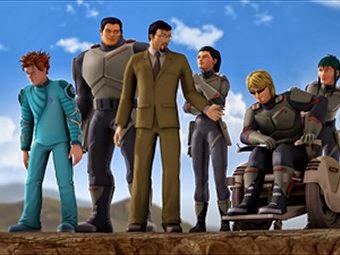
Once in a while Netflix completely surprises me and shows me something that I really like. In this case, it’s the animated superhero show The 99. The 99 is a 26-episode series written by Dr. Naif Al-Mutawa, that focuses on a group of heroes who are powered by magical gems called Noor stones. Supposedly, there are 99 stones. Each stone grants it’s user different powers. The first one to be found is a paraplegic man with the power to send out pain waves/healing waves from his hands: John Weller.

   The others found all have different abilities and powers, and all have Arabic names given to them once they join the 99. I suspect it has to do with the 99 names of Allah…well, and 99 Noor stones. Of course, I myself am an Agnostic, but I love discussing multiculturalism! As for the superheroes: There is (mainly) Jabbar The Powerful, (Superstrength and invulnerability) Darr The Afflicter (John), Mumita The Destroyer (Superstrength and agility.) Noora, The Light, (Light-based  powers and  empathy.) Jami The Assembler (Super engineer.) Those are the main three from what I see. Although the series plays off of Islam, the show itself is more about universal values of good and evil, and happens all around the world (Hong Kong, St. Louis, Hungary, and Jakarta, to name a few…) just  like the X-men and the mutants.
     
Dr. Ramzi Razem serves as the mentor (The Professor X, if you will.) of The 99. One thing I liked about the show was how well it depicts in my mind, how people would react to being superheroes. John doesn’t just get on a plane and fly off with them! No! He tells them to get out of his house and go away until his powers go out of control and they chase him down! Although John is a little bitter in the beginning, and generally has a negative view of his chair (Except when The 99 upgrade it into a sort of armored Permobil powerchair!) I tend to think that’s due to his tough-as-nails persona and background, rather than pity.

    In fact, I have to say, for all it’s cheesiness, I really liked The 99’s depiction of John’s disability. He sort of moves extra-consciously…with a click before he moves from his powerchair of course. And although I never realized it…that’s how I move too. I sort of have to think “Okay, turn here; then straight ahead.” but of course it’s all habit. Early episodes have some nice examples of John’s POV, all punctuated with clicks from his chair. Little things like this I notice. I’m always somewhat pleased when I see disability in mainstream superhero media!

     Of course, opposite Ramzi and The 99 is Raghul. Raghul is the Magneto to The 99’s X-men. A nice plot twist occurs when John becomes suspicious of why Ramzi brought them to The 99 Mansion, and gave them codenames. Why do superheroes need secret identities, anyway? (I know, to protect their loved ones.) It turns out that they had been working for Raghul, and the man they were told was Raghul was Ramzi! Nice twist on the secret identity theme. Anyway, Ramzi reasons that since they already have codenames and a secret base, he might as well use them for Good.

     The base of The 99 is in Selville, Spain, on the ruins of a 13th century Islamic library. I like how the show is based in Arabic/Islamic mythology and culture, and explores themes of ethics, social justice, and multiculturalism, in much the same way as X-men does…but just as X-men is not specific to any religion…The 99 has a different cultural/historical setting which adds to the backgrounds of the characters and Good vs. Evil narrative of the show.

Though Islamic culture is important to the show, the religion is never explicitly  discussed. Though I felt like maybe it’s time we have strong Islamic superheroes? I felt like it was a missed opportunity. It’s time we had a serious intercultural dialogue in that respect. If Nightcrawler can discuss Christianity, why not John Weller discuss Islam? Though I really like that the show went for (to me.) something new, to show how people act on cultural values; and for including a bit of disability culture as well.

The only thing I didn’t like about this series was…the animation. Until Beware The Batman proved me wrong, I’ve always kinda thought 3D animation was inherently clunky and awkward…and it’s still pretty bad here. Often, it feels more like a product of the late 90s than modern animation…but the action and themes covered are good, even though animation is lacking! If you’re looking for more disabled superheroes, or just a new show to watch about superheroes, I highly recommend The 99 for its cultural settings, sneaky plot twists, and cool superheroes! I’d rate this 3.5/5 stars, but just for animation issues! Give it a watch! I was pleasantly surprised!


Tuesday, October 1, 2013

ReelAbilities Film Festival 2013 Preview

ReelAbilities Film Festival 2013 Preview:


Well, I always love the ReelAbilities Film Fest in Columbus! You get to see movies dealing with disabilities and even discuss it afterwards, which is a rare opportunity to make one’s viewpoint as a person with a disability heard. It’s even better, because they always have international entries. So, I get to do some intercultural analysis as well.

     This year they have two entries from Germany, one from China, one from Portugal, one from Israel about a disabled soccer (Football to international viewers.) team. Other entries deal with Down Sydrome, (Yo Tambien, Spain.) and Aspberger’s (The clayamation feature Mary and Max, from Australia.) Longtime viewers of this blog know how important it is to me to promote strong, human portraits of disabilities. And I think ReelAbilities gives us all the opportunity to look at those kind of portraits. The festival begins Oct. 4 and ends on the 7th.

I will go to at least one showing…probably on the 6th, as I am close by the Wexner Center for The Arts. They will show “Yo Tambien” (“Me too”, from Spain.) and Renn Wenn Du Kannst (Run If You Can, from Germany.) Renn Wenn Du Kannst is about a paraplegic man in love with his nurse aide’s love interest. Since I speak German, I definitely want to go when one of the German movies is playing.

The Spanish film will probably remind me of Spain, which is a beautiful country. But, anyway, I rarely see disability films in an international context, so ReelAbilities is a real treat for me.
 
If you’re in the Columbus area, you can catch all the times by going to: columbus.reelabilities.org. Tickets are $5 at the door. If you’re an international reader, let me know of some good films with disabilities in them, and I will submit some requests. If you’re too far away to attend, I’ll provide analysis of the films after I see them to give you a taste. Regrettably, I think I’ll only be able to go to the one screening this year. But, we’ll see.
 
As usual, it should be a fun time, and give me a chance to share my human experience with others who have disabilities. We’ll have some guest speakers, one of whom I know is the poet from last year’s festival. In any case, it should be fun to see some disability stories with a little bit of international flavor! Maybe I’ll see YOU there!


Tuesday, September 10, 2013

DAREDEVIL (2003):


DAREDEVIL (2003):

Daredevil: “They say your whole life flashes before your eyes when you die. And it's true, even for a blind man.”

    Daredevil is all over the place tonally. The opening scene is of Daredevil crashing through a roof, crawling on the ground and then rolling over before being helped up by a priest. Yeah, you don’t want your superhero to appear physically inept before the movie even starts. That’s not a good sign. Though it offers a portrayal of disability, I couldn’t discern what the ethos of it was, but it definitely wasn’t an uplifting one, and straddles, at times, a tone of pity IN A SUPERHERO MOVIE. Pity doesn’t belong in a superhero movie!
 
For every client Matt Murdock investigates and then beats up in the movie, he throws a fit and goes to a confession booth to tell the priest he’s not the bad guy. The trouble is, we know that, as an audience. We want to see Daredevil kick butt, and…for as much as he does…he spends an equal amount of time on the ground, in a confession booth, or throwing a fit. The problem is that Daredevil is never given the chance to be a competent disabled superhero.
 
 In his alter ego as Matt Murdock he’s shown to be a smooth-talking ladies’ man, but he goes passive-aggressive after he loses a criminal who could lead him to Kingpin, and even has to tell the criminal’s young son: “I’m not the bad guy.” He meets Elektra Nachios (A name that makes me laugh because it sounds like nachos.) after the two of them fight and meet cute.

    That’s another problem with this movie. It tries to introduce Daredevil, Elektra, Bullseye and Kingpin (Played marginally well by Michael Clarke Duncan…but he’s just sort of…there to be evil.) Plus, they try to give you an origin story. All that just can’t fit in one movie. It can’t be a comic book movie/noir/rom-com. Another thing that gets annoying is the references to comic book artists…some of the criminals are named Bendis, Miller, Quesada…Murdock’s client is called Mr. Lee. Ha! (But, surprisingly, Stan’s cameo is as a random pedestrian instead of a client!) Also, Kevin Smith is in forensics…okay, we get it, it’s a superhero movie!

   It’s just a shame they couldn’t show that by actually having the hero be heroic. During the course of the movie he’s nearly defeated 3 times (By Elektra, Bullseye, and nearly Michael Clarke Duncan…who you might know as almost EVERYONE ELSE IN THE MOVIE.) The first defeat comes when Elektra outfights him. The second defeat is after Bullseye kills Elektra, and Daredevil’s saved by…wait for it…bats that fly through the church window. Who’s movie is this?

 Oh yeah and Bullseye kills nearly everyone he meets with pointed things, and that gets freakish and annoying. He kills a talkative granny on an airplane with a well-aimed peanut she chokes on! That’s not cool…that’s weird. How do you aim a peanut?
 
Now, I will give the film credit for at least tangentially dealing with disability and coping mechanisms. Daredevil folds his bills different ways in his wallet, uses adaptive computer equipment, and of course uses his cane, which doubles as a grappling hook/Bo staff. They have him use his radar image trick effective in some scenes, but admittedly, it’s a gimmick to help him out of tight spots. There’s a trick he uses where the sound of water outlines people. I thought that was cool, but still a gimmick.

    I cringed a lot watching this movie again…even if it does foreshadow….(I know I promised no more Batman!) Ben Affleck as a possible Batman. The film even tries to introduce the stories of two main characters…Elektra and Daredevil…just like Batman vs. Superman will attempt to do. Here’s hoping Affleck is older and wiser. And a lot less apologetic.

My main beef with the movie is the portrayal of the disability…although I agree that the noir/rom-com tone was unsettling and that might be the bigger beef with mainstream viewers. But, let’s see…aside from his super senses, he’s easily defeated, constantly needs help from Elektra (Who the movie introduces and then kills.) or random priests, and his super senses are easily overcome by noise…he’s got super hearing! Shouldn’t he have worked that out? In this movie, far from being a superhero, Daredevil looks weak, pitiful, and dumb.

    I watch superhero movies to escape my disabled body. No question about it. But, Daredevil’s disability (at least in the eyes of this movie.) is only a superpower when it advances the plot. The rest of the time it puts him in self-doubt and leaves him ultimately pining for the acceptance (and sex…) of an able bodied woman. (Ben Affleck’s now-wife, Jennifer Garner, whom he first met on this set.)

     If superhero movies should do anything, they should uplift people (of all abilities.) and make them feel like they can do anything. But, what do we say about a man who gets beat up 3 times in his own superhero movie? He looks weak, and trapped by his disability. I realize this film doesn’t exactly cater to disability rights, but it should’ve at least been a superhero movie. 1 star for this dull action/comedy/noir that will make you glad Marvel is sticking to action-comedies. Perhaps Affleck knows noir is more a Batman schtick.


Monday, August 26, 2013

Matsuricon 2013

                                                     (Aaron and I pose in front of a Dalek!)  

                      (I encountered another 11th Doctor. He was nice enough to show me his screwdriver!)

Two days ago, I went to Matsuricon 2013 at The Regency Hyatt Hotel in Columbus, OH! It was fun, and I loved just going around looking at all the cool costumes. One of the things I like about Matsuricon is that everything is kind of weird, but in a good non-judgmental way. It really spoke to me artistically. This time I went with my brother and best friend. My brother was the 10th Doctor, I was the 4th Doctor, and my best friend was the 11th Doctor. All our costumes had the Doctor Who theme. All 3 of our nametags said “The Doctor” too, so that was cool.

Speaking of costumes, I met quite a few other Doctors as well, and took some pictures. We also played board and card games, and I bought a set of Doctor Who sonic screwdrivers. I saw quite a lot of people with disabilities too, and in fact got some pictures with them too. The good thing is that Cons are usually always accessible. Later on, I bought a DVD set of Gantz. Then, I bought a print from Full Metal Alchemist, which is a great anime.  

My brother wanted to check out the videogame section where they had a Super Smash Bros. Melee tournament going on. So, we did that for a while, and then played one of our board games we rented in the board game room, a game called Pandemic. It’s a pretty cool game where you have to stop disease outbreaks cooperatively with each player being given a special role and special skills. I played the medic role. Recommended game!

Also, I met a lot of people who complimented my outfit, and let me take pictures. I think meeting people is probably the most fun. Plus, the cool souvenirs. The stuff that I see at cons is unlike anywhere else. Disability doesn’t matter. People are usually friendly, and you get to share your enthusiasm, and discover all kinds of neat people, toys, art, and games that you (likely) won’t see anywhere else!

I hope I get to go again! I always love going to cons! There is so much to do and see once you are there! I actually have more pictures, but I’m still waiting on some of them. Had a blast though! Hopefully, I’ll go to more cons as they come around! And meet cool people with and without disabilities! Stay tuned!

                                         Left to right: Aaron, brother, me. Note the cheese.
                                             

                                 (Me with another 4th Doctor! Screwing around with sonic screwdrivers!)

Thursday, August 15, 2013

Elysium (2013)


Elysium (2013)

Max: “I need to get to Elysium.”

After taking a lethal dose of radiation while at his job, Matt Damon (Max) is given five days to live. Earth has turned into ruins, and the rich live above them in space in a place called Elysium. Of course, the robots don’t care about the humans on Earth. They only care about the humans on Elysium. So, after Max is harassed by robots the entire beginning of the movie, and then haphazardly given anti-radiation pills and five days to live, he realizes he needs to get to Elysium.

  But, the people on Elysium are all rich and healthy. They don’t want to welcome the power and the sick. Visually, Elysium is white and pristine, while Earth is like a grimy desert. Earlier in the movie, we see the rich people have no problem shooting down the poor, and I mean with missiles and an assassin named Kruger. So, to get around this Max visits his buddy Spider who outfits him with a cyborg exosuit that contains all of Elysium’s data.

      Astute William Gibson readers will notice this is the exact plot of the 1981 short story Johnny Mnemonic, only the affluent Megacorporations are in space, and the assassins aren’t with the Yakuza. A good amount of the film is in Spanish, whereas “Johnny Mnemonic” favored Japanese as the local language. Those similarities aside, Max tells his romantic partner he’s going to Elysium, and she wants her daughter to come with him, because she has leukemia, and they can cure disease on Elysium.

     One of the things Max’s cyborg body has the power to do is shut down Elysium. After a raid on Kruger’s men, Max’s buddies are wounded and looking for a way to get to Elysium, now that they have leverage. Frey’s (The romantic interest) daughter tells him a cute story about a monkey standing on a hippo’s back to get all the fruits it wants. From there, he gets the idea to threaten suicide if not taken on a ship. Again, that’s straight from Gibson…but, as Gibson is the father of cyberpunk, where there’s no middle class, it’s hard to escape his influence when making a cyberpunk movie.
 
I don’t know, I probably spoiled enough already, but then the movie becomes sort of predictable. There’s a big fight with Kruger on Elysium, and then he reboots Elysium to allow Earth citizens. One of the things I liked about it was that it shows the differences in class very well visually. Some Earth stuff is high-tech, but it doesn’t exist to serve them. Also, the people on Elysium abuse the language of disease to characterize Earth’s population. John Carlyle, the evil Secretary’s associate quips: “You think I like breathing this air?”

Everything on Earth is considered a burden, in true cyberpunk fashion. The only piece of technology that really serves the low class (as in Johnny Mnemonic!) is the protagonist’s cybernetic access to data the high class needs, and it’s part of his body. This theme always appeals to me as a disability theorist. How technology gives us strength! And along with the data, Max’s exosuit also grants him increased strength, because essentially he’s covered in a robotic chassis.

While such robotic technology appeals to me, I can’t help but think it might be used to “cure” the disability experience, which is my choice to live. Certainly, medical themes are prominent throughout Elysium. But, those are in life-threatening cases. The point is that just because someone has a disease, doesn’t mean they are a disease, and Elysium drives that home well!
   
In conclusion, it has some cyberpunk tropes that I’ve seen before…down to the computer expert named Spider who outfit’s the hero. But, it’s been a while since I’ve seen an honest-to-goodness cyberpunk action movie! So, I loved it! It’s got great action, with assassins and cyborg battles dominating most the movie. I just wish they didn’t draw so heavily from Johnny Mnemonic. (And no, I don’t mean the 1996 movie adaptation…though maybe I’ll review that later.)

Fans of cyberpunk and sci-fi should be pleased. Max could’ve been Keanu Reeves! (That’s a Johnny Mnemonic joke!) Matt Damon seems to draw from his Bourne Identity experience, and delivers a strong, socially conscious action hero that works well in the cyberpunk genre, showing the benefit of technology mixed with humanity. As far as a rating, I’ll give this movie a solid B!